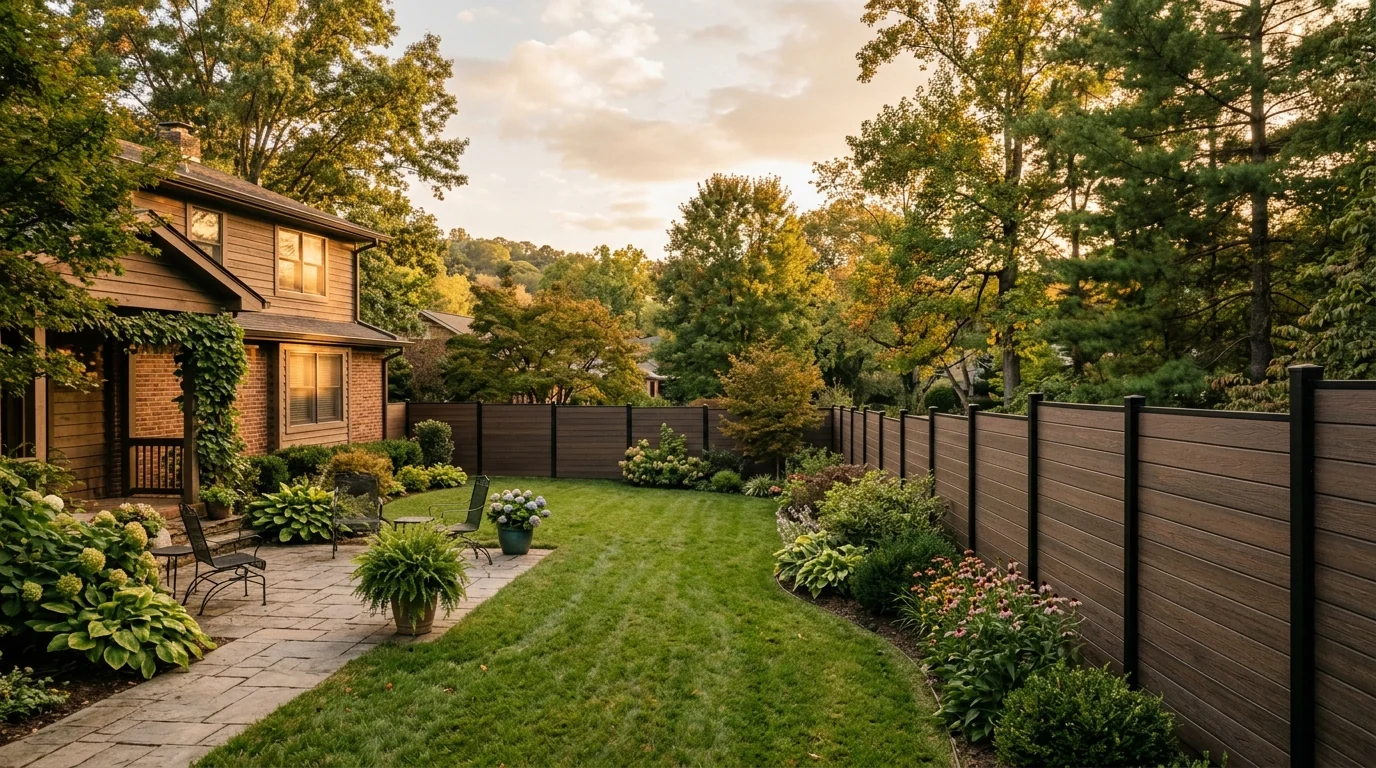
What is composite fence installation and when is it the right choice?
Composite fence installation is the process of setting pressure-treated or aluminum posts and attaching composite panels or boards made from a blend of wood fiber and recycled plastic. The result looks and feels like painted or stained wood but does not rot, split, or require periodic refinishing. For Knoxville homeowners dealing with the area’s roughly 47.9 inches of average annual rainfall (NWS Morristown, 1991-2020 Climate Normals) and the wet-dry shrink-swell cycles that Knox County’s limestone-derived clay soils produce, composite delivers a measurably lower maintenance burden than wood over a 10-to-25-year horizon.
How composite fencing works mechanically
Each composite board or panel is manufactured by combining wood fiber with a thermoplastic binder, usually polyethylene or polypropylene, under heat and pressure. The plastic encapsulates the wood fiber, blocking the moisture uptake and oxygen exposure that fungi and insects need to break down organic material. Posts are typically pressure-treated pine or powder-coated aluminum. Panels attach to posts using composite-rated hidden fasteners or stainless screws that allow slight thermal expansion without visible gaps or buckling.
The conditions composite is designed for
Composite fencing fits best in three situations: yards where homeowners want a wood-grain aesthetic without annual staining, properties with significant moisture exposure such as low-lying lots or fence lines adjacent to Knox County’s many drainage swales, and subdivisions where HOA covenants permit wood-look materials but the homeowner wants to avoid the ongoing upkeep. It also suits pool enclosures well, since the CPSC Safety Barrier Guidelines for Home Pools require a minimum 48-inch barrier height with self-latching gates, and composite handles constant splashzone moisture without degrading.
When an alternative is the better choice
Composite is not the ideal pick for every project. If budget is the primary concern and a homeowner is comfortable with a five-to-seven-year maintenance cycle, pressure-treated Southern Yellow Pine still costs less upfront in the Knoxville market. If the homeowner wants zero wood content whatsoever, such as in a severe moisture or chemical environment, vinyl fence installation eliminates organic material entirely. Vinyl also handles the routed-channel panel system that some privacy fence styles require and is widely available through local suppliers in West Knox.
Installation process
Composite fence installation follows a defined sequence. Disruption to the yard is moderate: a crew typically completes a standard 150-to-160-linear-foot residential project in one to two days, consistent with the average Knoxville project size of roughly 155 linear feet.
Step 1. Site survey and layout (half a day before installation)
Before any digging, the crew marks the fence line using spray paint or string line, locates underground utilities through Tennessee 811 (Tennessee’s free dig-safe service), and confirms property line setbacks. Knox County corner lots face different setback rules under City of Knoxville code, Town of Farragut ordinance, and unincorporated county standards, so this step catches jurisdiction-specific conflicts early.
Step 2. Post hole excavation
Post holes are dug with a gas-powered or skid-steer-mounted auger to a minimum 30-to-36-inch depth for standard 6-foot panels. Ridge-position lots in Knox County often hit shallow limestone bedrock at 18 to 24 inches, which requires rock augering or alternative anchoring methods. Spacing between posts follows the specific composite manufacturer’s span requirement, typically 6 or 8 feet on center.
Step 3. Post setting
Posts are set in fast-setting concrete. This Old House’s vinyl fence installation guide notes a standard practice of digging holes 3 feet deep, sliding the post into wet concrete, and using a level to confirm plumb. The same fundamentals apply to composite fence posts. Crews check plumb on two axes and brace posts until the concrete cures, usually 24 to 48 hours. Top rails and bottom rails attach after the concrete sets.
Step 4. Panel or board installation
Composite panels slide between posts or composite boards attach to rails using hidden fasteners. Fastener type matters here. Standard galvanized screws can react with certain composite formulations over time. Manufacturer-specified composite-rated fasteners or stainless steel are the correct choice. On sloped lots, common across Knox County’s Valley and Ridge terrain, the crew uses either a racking technique (the panel tilts to follow grade) or stepped installation (panels drop in uniform increments along the slope). Not every composite profile supports racking, so this decision should happen at the material-selection stage, not on installation day.
Step 5. Gate installation and hardware
Gate posts are set in their own concrete footings, typically with additional depth or a larger-diameter pour to handle the lateral load of a swinging gate. Pool gates must be self-closing and self-latching per CPSC guidelines. Composite gate frames require metal internal reinforcement in most configurations to prevent long-term sag.
Step 6. Final inspection and cleanup
The crew checks panel alignment, confirms gate swing and latch function, and removes concrete spoils and packaging. Homeowners should walk the line before the crew leaves and note any panels that are not seated flush or any fasteners that are visible when they should be hidden.
Composite fence installation vs. vinyl fence installation
Both composite and vinyl eliminate the wood maintenance cycle that plagues pressure-treated pine in Knox County’s humid climate, but they solve the problem differently and suit different buyer priorities.
Composite uses wood fiber as a structural and aesthetic component. The grain texture is genuinely three-dimensional, which is why many HOA architectural review boards accept it where they might reject a flat vinyl panel. The tradeoff is that composite can show slight surface fade in the first 12 to 18 months as the color stabilizes, though quality composite lines with UV inhibitors minimize this. Vinyl does not fade in the same way because there is no organic content to weather.
On cost, composite and vinyl occupy overlapping ranges. Bob Vila’s fence installation cost guide reports vinyl fence installation at a national average range with per-foot costs that run roughly comparable to mid-grade composite. The installed cost difference on a typical 155-linear-foot Knoxville project is often under $500 either way, making the material-preference and aesthetic decision more significant than the budget decision for most Family-First buyers.
Where composite pulls ahead is in situations where a realistic wood appearance matters, HOA covenants specify a wood-look material, or the homeowner plans to sell and wants a fence that photographs as warmly as stained cedar. Where vinyl pulls ahead is in applications demanding zero organic content, specific panel profiles that composite does not offer in the same price tier, or when the homeowner’s budget window is tight and a full vinyl line at the low end of the range is available.
For a full side-by-side breakdown of vinyl, visit vinyl fence installation details for the Knoxville area.
Composite fence installation cost in Knoxville, TN
Bob Vila’s fence installation cost guide reports the national average fence installation cost at $3,059, with a typical range of $1,743 to $4,431. Composite material sits at the mid-to-upper end of that range given its higher per-board cost relative to pressure-treated pine. In the Knoxville metro, typical composite fence projects land between roughly $1,900 and $5,800 depending on scope, which aligns with the local average project cost range for residential fencing.
Several local variables move the number within that range:
Post depth and soil conditions. Knoxville’s moderate-to-high shrink-swell clay soils (USDA Web Soil Survey, Knox County) require adequate post depth and concrete volume. Ridge lots with shallow bedrock add rock-augering labor costs.
Fence height. A 6-foot privacy profile uses more material than a 4-foot decorative line. Most Knox County HOA covenants cap privacy fences at 6 feet, so the majority of residential projects land at that height.
Gate count and type. Each pedestrian gate adds hardware cost and labor time. A double drive gate adds significantly more. Gates are frequently where per-quote surprises originate, so ask for gate pricing itemized separately.
Access to the fence line. Narrow side yards, tree roots, or grade changes that prevent equipment access shift labor to hand-digging and hand-carrying, increasing time on site.
Jurisdiction and permits. City of Knoxville and Knox County permits for fences over 6 feet typically run $40 to $90. The Town of Farragut’s design review process can add time, though not typically large permit fees.
For a detailed cost estimate specific to your project dimensions, see the composite fence installation cost breakdown for Knoxville.
Warranty and transferability
A strong composite fence warranty should cover rot, splitting, insect damage, and structural delamination for at least 20 years, with the best manufacturers offering 25-year transferable coverage. Transferability matters in the Knoxville market because it adds value at resale. A fence backed by a transferable warranty is a documented feature, not just a selling point in a listing description.
When reviewing warranty language, ask three specific questions. First, does the warranty cover labor and removal, or only materials? A material-only warranty leaves the homeowner paying for reinstallation if a panel fails. Second, does coverage apply to color fade or only structural failure? Composite products with UV inhibitors should back that claim with measurable fade thresholds, typically measured in delta-E color units. Third, is the warranty voided by third-party installation? Some composite lines require certified installer documentation for warranty activation. Confirm this before signing a contract with any installation crew.
For Knoxville homeowners in HOA-governed communities, check whether the HOA’s own maintenance covenant places any requirements on the homeowner that could conflict with the manufacturer’s warranty terms. Farragut and Northshore HOAs occasionally have covenants about approved finish treatments that could inadvertently void a composite finish warranty if a homeowner applies a sealer the manufacturer did not approve.
Permits and engineering in Knox County
Permit requirements for composite fence installation in the Knoxville area divide by jurisdiction, and the lines matter.
City of Knoxville. A building permit is required for any fence over 6 feet in height and for fences in historic overlay or design overlay districts regardless of height. Contact City of Knoxville Plans Review and Inspections before breaking ground on any project within city limits that is near an overlay boundary, since parcel maps do not always make overlay status obvious at street level.
Unincorporated Knox County. A permit is required for fences over 6 feet. Contact Knox County Codes Administration and Inspections. Standard residential projects under 6 feet in unincorporated Knox County do not require a permit, but property owners are still responsible for setback compliance and cannot build over utility easements.
Town of Farragut. Farragut operates its own Community Development department with fence ordinances that go beyond standard HOA covenants. Any fence project within Farragut town limits should begin with a pre-application conversation with the Town’s Community Development staff. The design review process in Farragut can require material samples, color specifications, and elevation drawings, particularly for composite products that a reviewing officer has not seen before.
Pool enclosures. If the composite fence encloses or partially encloses a pool, IRC pool barrier requirements apply regardless of jurisdiction. That means a minimum 48-inch height on the pool side, self-closing gates, and self-latching hardware positioned so a child cannot reach through the fence to operate it.
Engineering review is not typically required for residential fences in Knox County unless the fence is over 8 feet, is retaining any grade change, or is part of a commercial property. Karst sinkhole zones, documented on Tennessee Geological Survey mapping, occasionally prompt a soil-conditions review in unincorporated Knox County, but this is uncommon for standard residential fence footings.
If you are ready to scope your project, request a composite fence installation quote for Knoxville and a crew will confirm permit requirements for your specific parcel before any work begins.
For homeowners also researching how to address existing fence damage, the fence repair options available in Knoxville cover the most common post and panel failure patterns seen in the area.