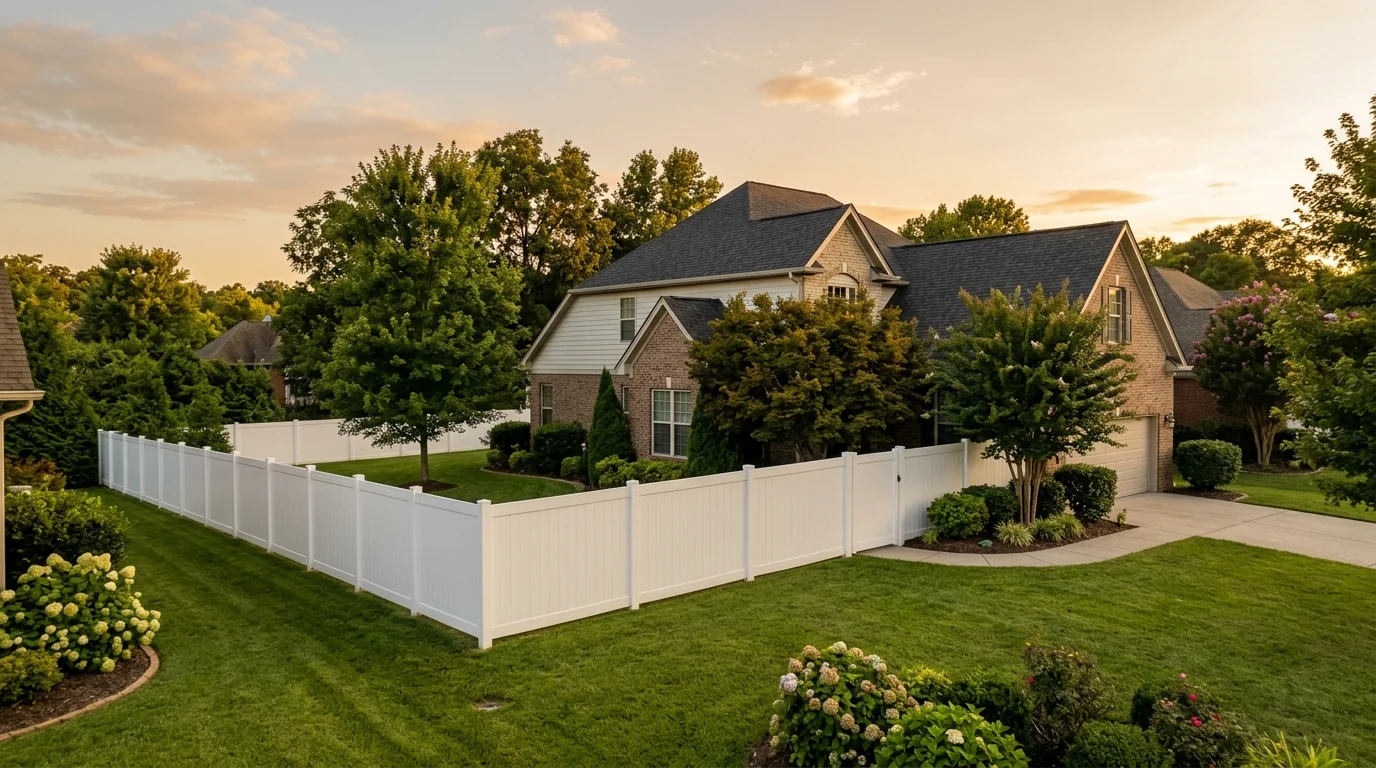
Vinyl Fence Installation in Knoxville, TN: Wood vs Vinyl Fence, Costs, and What to Expect
If you are comparing wood vs vinyl fence for your Knoxville yard, the short answer is this: vinyl costs more upfront, requires almost no ongoing maintenance, and suits newer subdivisions where clean lines and low-upkeep living are the priority. Wood costs less per foot to install, offers more aesthetic flexibility, and remains the dominant choice across older Knoxville neighborhoods, but it demands regular staining or sealing to survive Knox County’s nearly 48 inches of annual rainfall (NWS Morristown 1991-2020 Climate Normals).
This page covers what vinyl fence installation actually involves, how the process works step by step, where costs land locally, and what permit requirements apply depending on whether your property sits inside the City of Knoxville, the Town of Farragut, or unincorporated Knox County.
What is vinyl fence installation and when is it the right choice?
Vinyl fence installation places extruded PVC posts, rails, and panels into a concrete-set footing system. The panels clip, slide, or lock into routed channels in the posts. No painting, no staining, no annual sealing.
How vinyl fence works mechanically
Posts go into concrete footings, typically 30 to 36 inches deep in Knox County conditions, and the PVC panels interlock or slide into horizontal rail channels. The system is modular: standard widths snap together without exposed fasteners, which is why a freshly installed vinyl fence looks uniform along its entire run.
Conditions where vinyl is the right call
Vinyl performs best for homeowners who want a privacy fence that holds its appearance for years without weekend maintenance projects. In West Knox subdivisions like Hardin Valley and Northshore, where newer homes sit on smaller lots and HOA design standards favor consistent aesthetics, white or tan vinyl privacy panels fit both the neighborhood look and the covenant requirements. Vinyl also handles Knox County’s wet soil conditions better than untreated wood. The PVC will not rot, splinter, or absorb moisture.
Families adding a backyard fence to keep children and pets contained, and who do not want to re-stain the fence every two to three years, are typically the best candidates.
When wood or another material is a better fit
In older Knoxville neighborhoods such as Sequoyah Hills, Bearden, or Fountain City, wood fencing blends more naturally with the established architectural character of the area. Vinyl’s limited color palette (white, tan, gray, and a few others) does not suit every property. For buyers who want to paint their fence a custom color or match an older home’s trim, wood fence installation in Knoxville gives more flexibility. On sloped lots in Knox County’s valley-and-ridge terrain, wood can be racked to follow grade more forgivingly than most vinyl panel systems, which step down in flat increments.
How vinyl fence installation works: the step-by-step process
Step 1: Property line verification and layout (Day 1 morning, 1-2 hours)
Before any post goes in the ground, the crew marks the fence line using your survey or property pins. In Knox County, installing on or over a property line creates neighbor-dispute exposure. In Farragut, the setback rules differ from both the City of Knoxville code and unincorporated county rules, so verify the setback requirement for your jurisdiction first.
Step 2: Post-hole digging (Day 1, 2-4 hours depending on access)
A power auger drills holes at the post-spacing interval specified by the panel manufacturer, usually 6 to 8 feet on center. Knox County’s residual clay soils are generally cooperative, but ridge-position lots with shallow limestone bedrock may require rock-auger bits, adding time and cost. As This Old House notes in their vinyl fence installation guide, holes should be dug 3 feet deep to get below the frost line, and the post must be set plumb in wet concrete and confirmed with a level before the concrete cures.
Equipment needed: a tow-behind or skid-steer auger for most residential lots. Backyard access matters. A gate width of at least 36 inches is usually required for equipment entry. If the backyard is not accessible by machine, hand digging or a smaller one-man auger will add 2 to 4 hours.
Step 3: Post setting and concrete cure (Day 1 afternoon, then overnight cure)
Posts go into the wet concrete, get checked for plumb on two axes, and are braced until the concrete sets. Most crews leave the posts overnight before attaching panels, which prevents any lean from developing as the concrete dries. On tight-schedule jobs, fast-set concrete can reduce this to four to six hours, but an overnight cure is the standard recommendation.
Step 4: Panel and rail installation (Day 2, 3-6 hours)
Rails slide into routed channels in the posts, and fence boards or full privacy panels drop into the rails. Gates get hung and adjusted for swing clearance and self-latching function. For pool enclosures, the gate must be self-closing and self-latching per IRC requirements and the CPSC Safety Barrier Guidelines, which specify the top of the barrier be at least 48 inches above grade measured on the side facing away from the pool.
Step 5: Cleanup and final walkthrough (Day 2 close, 1 hour)
Crews remove concrete bags, auger spoil, and packaging. A final walkthrough checks plumb, panel gaps, gate operation, and overall line. On an average 155-linear-foot Knox County job (the local average project size), a two-person crew typically finishes panels in a single day once posts are cured.
Wood vs vinyl fence: choosing the right material for Knoxville
The wood vs vinyl fence decision in Knoxville comes down to three factors: how much time you want to spend on maintenance, what your neighborhood or HOA requires, and whether the terrain on your lot creates installation complexity.
Where vinyl wins. In newer West Knox and Farragut subdivisions, vinyl is increasingly the default choice for privacy fencing. Homeowners in those communities want a fence that looks the same in year ten as it did in year one. Vinyl does not require fence staining, does not gray out, and will not host the moisture-driven rot that Knox County’s 47.9 inches of annual rainfall accelerates in untreated or under-sealed wood. For pet-containment or child-safety applications where the fence simply needs to function reliably, vinyl’s lifetime warranties on panels are a genuine advantage.
Where wood wins. Wood’s cost-per-foot is lower (see the cost section below), and it offers visual warmth and customization that vinyl cannot match. In Knoxville’s older in-town neighborhoods, a white vinyl privacy fence reads as a style mismatch next to cedar-sided bungalows and craftsman homes. Wood also handles sloped terrain better. Because individual boards are fastened to posts, a wood privacy fence can rack on an angle to follow a hillside. Vinyl panels step down in fixed increments, which can leave gaps at the base on grades steeper than about 2 inches per panel span.
The honest edge cases. Vinyl panels can crack if struck hard in cold weather. Knox County winters include ice-loading events, and a heavy limb falling on a vinyl fence in January can shatter a panel in a way that a wood board would simply dent or split cleanly. Replacement panels are available, but matching color and profile years after installation can be difficult if the original product line has changed. Wood repairs are almost always simpler because a board is a board.
If you are still weighing options, review the fence installation cost breakdown for Knoxville alongside the wood alternative before committing.
Vinyl fence cost in Knoxville, TN
According to Bob Vila’s vinyl fence cost guide, the typical national range for vinyl fence installation is $2,292 to $5,799, with a national average of $4,045. The cost per linear foot runs $15 to $40 installed, with 6-foot privacy panels averaging $25 to $40 per linear foot and 8-foot panels running $30 to $45.
For a typical Knox County residential project of around 155 linear feet, that translates to a rough installed range of $3,900 to $6,200 before adjustments.
Local variables that shift the number:
- Depth and soil conditions. Ridge lots with shallow bedrock require rock augering, which adds equipment time and cost.
- Equipment access. A backyard with no wide gate or vehicle access requires hand digging or a smaller auger, adding labor hours.
- Gate count and style. Walk gates and double drive gates add $150 to $600 each depending on hardware and panel width.
- HOA design review. Farragut’s Community Development design-review process can require a specific panel profile or post cap style that costs more than basic residential grade.
- Permit fees. Knox County and City of Knoxville permit fees typically run $40 to $90 for fences within the standard height limits.
To get a number specific to your property and fence line, request a quote for your Knoxville fence project.
Warranty and transferability
A well-made vinyl fence panel carries a lifetime limited manufacturer warranty covering fading, peeling, cracking, and discoloration. That warranty is the primary reason many homeowners justify the higher upfront cost over wood.
The questions to ask before signing a contract:
Is the manufacturer warranty transferable? If you sell the home, a transferable warranty is a selling point. Many leading PVC fence manufacturers include transferability in the standard warranty, but confirm it in writing rather than assuming.
What does the installer warrant separately? Manufacturer warranties cover the material, not the workmanship. A one- to five-year labor warranty from the installer covers post setting, panel alignment, and gate function. One year is the floor; three to five years from an established local contractor is a reasonable expectation.
What voids the warranty? Impact damage from lawn equipment or fallen limbs is almost always excluded. Some manufacturers void warranties if a non-approved post cap or rail is substituted during installation. Confirm the product being installed is the same brand covered by the warranty documentation.
Permits and engineering in the Knoxville metro
Permit requirements vary significantly depending on which jurisdiction governs your lot.
City of Knoxville. A permit is required for any fence over 6 feet. Properties in historic overlay districts may require design review regardless of height. Contact the City of Knoxville Plans Review and Inspections office before installation.
Town of Farragut. Farragut has separate and notably stricter fence permitting and design-review standards beyond standard HOA rules. Farragut Community Development reviews fence applications and may require specific materials, colors, or setbacks. Do not assume that a style approved by your HOA has also cleared the Town’s standards.
Unincorporated Knox County. Permits are required for fences over 6 feet. Contact Knox County Codes Administration and Inspections. Typical permit fees across all three jurisdictions run $40 to $90.
For most standard 6-foot vinyl privacy fences in residential zones, engineered drawings are not required. Corner lots in all three jurisdictions are subject to sight-triangle setback rules that can limit fence placement near the street intersection. Check the setback map for your lot before the crew sets any posts.
Questions about fence compliance specific to your address can also be directed toward a local fence specialist serving the Knoxville service area. If you are dealing with a damaged or failing fence rather than new installation, see the guidance on common fence repair issues in Knoxville for post and panel repair options.