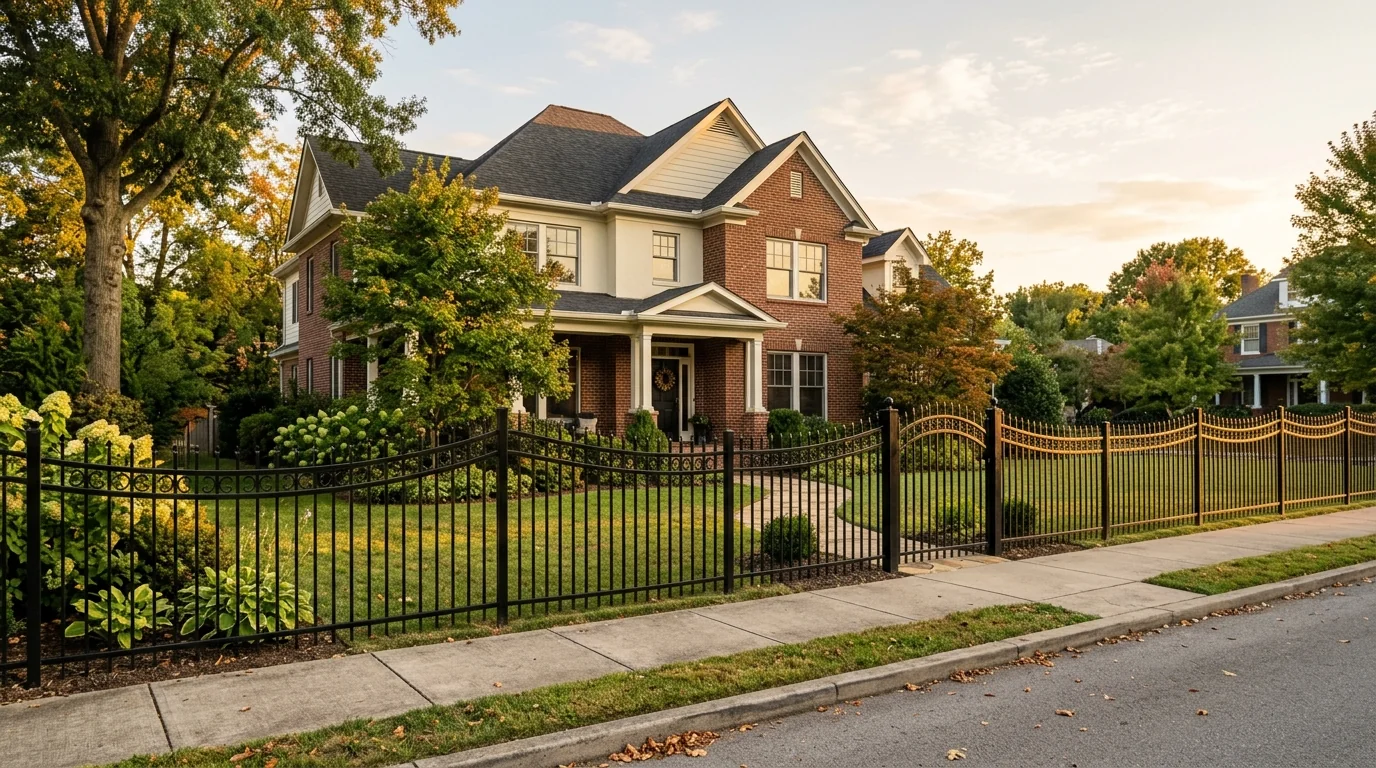
What is ornamental iron fence and when is it the right choice?
An ornamental iron fence is a steel or wrought-iron perimeter system built from vertical pickets, welded or bolted to horizontal rails and set into concrete-filled post footings. In Knoxville, it shows up most often at front entries, formal landscape beds, pool perimeters, and any property where a homeowner wants something that reads as permanent and architectural rather than purely functional. When neighbors or drive-by traffic will see the fence every day, iron’s weight, crispness of line, and classic spear-top profile are hard to match. If you are already comparing options, the aluminum ornamental fence installation page for Knoxville covers the closest alternative.
How it works mechanically
Steel posts are set into concrete footings typically 30 to 36 inches deep. Prefabricated or custom panels bolt or weld to the posts at precise spacing. The result is a rigid, load-bearing frame. Because iron is a ferrous metal, the factory applies a powder-coat finish (and sometimes a primer layer) that bonds electrostatically to the metal surface before baking in a curing oven. That hard shell is what stands between the iron and Knox County’s roughly 48 inches of annual rainfall (NWS Morristown KMRX, 1991-2020 Climate Normals).
The conditions it is designed for
Ornamental iron performs best where security and appearance share equal billing. The gauge is heavy enough to resist bending from impact, making it a credible deterrent at a street-facing perimeter. It handles Knox County’s moderate-to-high shrink-swell clay well because the rigid post-and-panel system does not flex and gap the way wood privacy boards can after wet-dry cycles. West Knox lakefront communities in Northshore and Choto frequently specify iron or its aluminum equivalent because the style reads as upscale and survives proximity to water better than wood.
Where an alternative is better
If the fence will sit within a few feet of a pool deck or any chronic wet zone, aluminum ornamental fence is the smarter call. Aluminum cannot rust regardless of coating integrity, which matters on a surface that gets splashed daily. Iron is also heavier per linear foot, which raises both shipping costs and labor time on steep ridge-position lots. For purely utilitarian enclosures (dog runs, vegetable gardens, utility areas), the cost premium of ornamental iron is rarely justified.
Installation process
Installing ornamental iron in a typical Knoxville residential yard takes one to three days depending on linear footage, gate count, and terrain. Here is how a standard installation unfolds.
Day 1: Layout and post setting
The crew marks post locations with spray paint or stakes, then calls 811 for a utility locate (required by Tennessee law before any digging). Post holes are augered to the specified depth, typically 30 to 36 inches in Knox County clay. On Farragut ridge lots where limestone sits close to the surface, a rock auger bit or hydraulic hammer may be required, adding a half-day and a rental cost to the project. Posts drop into the holes and concrete is poured. A level confirms plumb on each post before the concrete sets. Per guidance from This Old House on post setting, the post must be plumb and supported while concrete cures to prevent lean.
Day 2: Panel attachment
Once concrete achieves adequate set (usually overnight for fast-set mix), crews attach the prefabricated iron panels to the posts. Panels are bolted through pre-drilled flanges or welded directly, depending on the manufacturer’s system and the installer’s workflow. Rails and pickets are checked for level and consistent spacing. Gate frames are hung on heavy-duty hinges rated for the panel weight, and self-latching hardware is installed. Pool gates require self-closing, self-latching mechanisms meeting IRC standards and CPSC pool barrier guidelines.
Day 3: Touch-up, cleanup, and walkthrough
Any field cuts or drilled holes get a touch-up coat of matching paint or cold-galvanizing compound to seal bare metal. The crew sweeps the site, collects concrete bags and packaging, and walks the finished fence with the homeowner to verify gate swing, latch function, and any coating spots that need attention. Most installations in the 150-to-200 linear foot range that are common in Knox County’s average-sized residential lots wrap up within this window.
Ornamental iron fence vs aluminum ornamental fence
Both iron and aluminum ornamental fences look nearly identical in a catalog photo. Spear tops, diagonal picket spacing, and powder-coat black finishes are available in both materials. The differences emerge in weight, weldability, long-term corrosion behavior, and installed cost.
Iron is heavier, which makes it harder to damage accidentally and gives it a more solid feel when pushed or leaned against. It can be cut, bent, and welded on-site by any competent metalworker, which means repairs happen rather than replacements. A rusted rail, a bent picket from a car bumper, a gate hinge that has torn loose from the post, all of these are weldable problems. That on-site repairability keeps long-term ownership costs manageable for iron in ways that do not apply to aluminum.
Aluminum’s core advantage is that it cannot rust. On a pool deck, a waterfront lot in Northshore or Choto, or any site where the coating will face constant moisture, aluminum eliminates the maintenance task of monitoring for rust at welds and post bases. Aluminum is also lighter, which makes it easier to handle on steep terrain and lowers labor time per panel. Bob Vila’s fence installation cost guide puts aluminum at $17 to $90 per linear foot depending on grade and profile, which gives it a wider range than iron and reflects the large span between contractor-grade and architectural-grade products.
For most Knoxville front-entry and street-facing applications, iron’s prestige and repairability outweigh its moisture sensitivity as long as the powder coat is maintained. For poolside, lakefront, or any site with standing drainage issues, aluminum wins on practicality.
Ornamental iron fence cost in Knoxville, TN
According to Bob Vila’s fence installation cost guide, a wrought-iron fence runs $30 to $55 or more per linear foot installed. On a 155-linear-foot project (the typical Knox County residential job size), that translates to a rough range of $4,650 to $8,525 before gates and any site-specific extras. For a detailed cost breakdown specific to this material, see the ornamental iron fence cost page for Knoxville.
Several local variables push the number in either direction.
Fence height. A standard 4-foot ornamental panel costs less per section than a 6-foot panel. West Knox HOA communities frequently cap front-yard fences at 4 feet, which can keep material costs lower, but rear privacy requirements may call for 6-foot panels on the same job.
Gate count and style. A single walk gate adds $200 to $500 in most markets. A double drive gate wide enough for a vehicle can add $600 to $1,500 depending on width, panel weight, and whether an automatic opener is included.
Terrain and access. Knoxville’s Valley and Ridge topography means many lots step up or down across their depth. Racked panels (angled to follow a slope) require additional field fabrication time. Ridge lots in West Knoxville with shallow limestone bedrock add rock augering time and equipment.
Post spacing and soil conditions. Posts set in Knox County’s moderate-to-high shrink-swell clay benefit from deeper footings than flat-terrain markets. Additional concrete volume per post adds to material cost.
If you are ready to get a number specific to your property, request a quote for your Knoxville fence project and a local installer can walk the site before pricing.
Warranty and transferability
A strong ornamental iron fence warranty covers two separate things: the structural integrity of the fabrication (welds, post flanges, rail connections) and the powder-coat finish. Most reputable panel manufacturers offer 10 to 25 years on structural components and 5 to 15 years on the finish, with the finish warranty voided if the homeowner applies incompatible paint over factory coating.
Ask the installer these questions before signing a contract.
Is the manufacturer warranty transferable to a future buyer? Transferability adds real value at resale, and many Knox County buyers in Farragut and Northshore specifically ask about it. Is the installer’s labor warranty separate from the manufacturer warranty, and does it cover post heaving caused by soil movement? Knox County’s shrink-swell clay means soil movement is a realistic cause of post lean over time, and some installer warranties exclude it. Finally, does the warranty require annual maintenance (touch-up of chips, inspection of welds) to remain valid? That is a reasonable requirement, but it should be in writing.
A powder-coat finish that is maintained (chips touched up within a season of appearing) commonly lasts 20 years or more even in Knox County’s roughly 48-inch annual rainfall environment.
Permits and engineering in Knox County
Permit requirements for ornamental iron fences in the Knoxville metro depend on which jurisdiction the property sits in, and the lines matter.
City of Knoxville. The City of Knoxville Plans Review and Inspections office requires a permit for any fence over 6 feet in height. Fences within historic overlay districts (Fourth and Gill, Old North Knoxville, and parts of South Knoxville) may require design review regardless of height. Permit fees typically run $40 to $90 for a standard residential fence.
Town of Farragut. Farragut maintains its own Community Development permit process and is the most design-restrictive jurisdiction in the Knoxville metro. The Town requires fence permits for most new installations, reviews materials and finish colors, and enforces setback requirements that differ from City of Knoxville and unincorporated Knox County rules. Homeowners in Farragut should contact the Town of Farragut Community Development office before ordering any materials.
Unincorporated Knox County. Knox County Codes Administration and Inspections requires permits for fences over 6 feet. Below that threshold, no permit is required in most unincorporated areas, but HOA covenants in planned subdivisions like Hardin Valley and Karns may impose their own approval steps independent of county code.
Engineering drawings are not routinely required for standard residential ornamental iron fences in Knox County. They become relevant when the fence is part of a retaining structure, when it sits within a flood zone (portions of South Knoxville and West Knox lowland areas along the Tennessee River), or when it must meet a site-specific wind or load calculation for a commercial or mixed-use property.
Checking the service area information for Knoxville can help confirm which jurisdiction applies to a specific address before the permit application is filed.