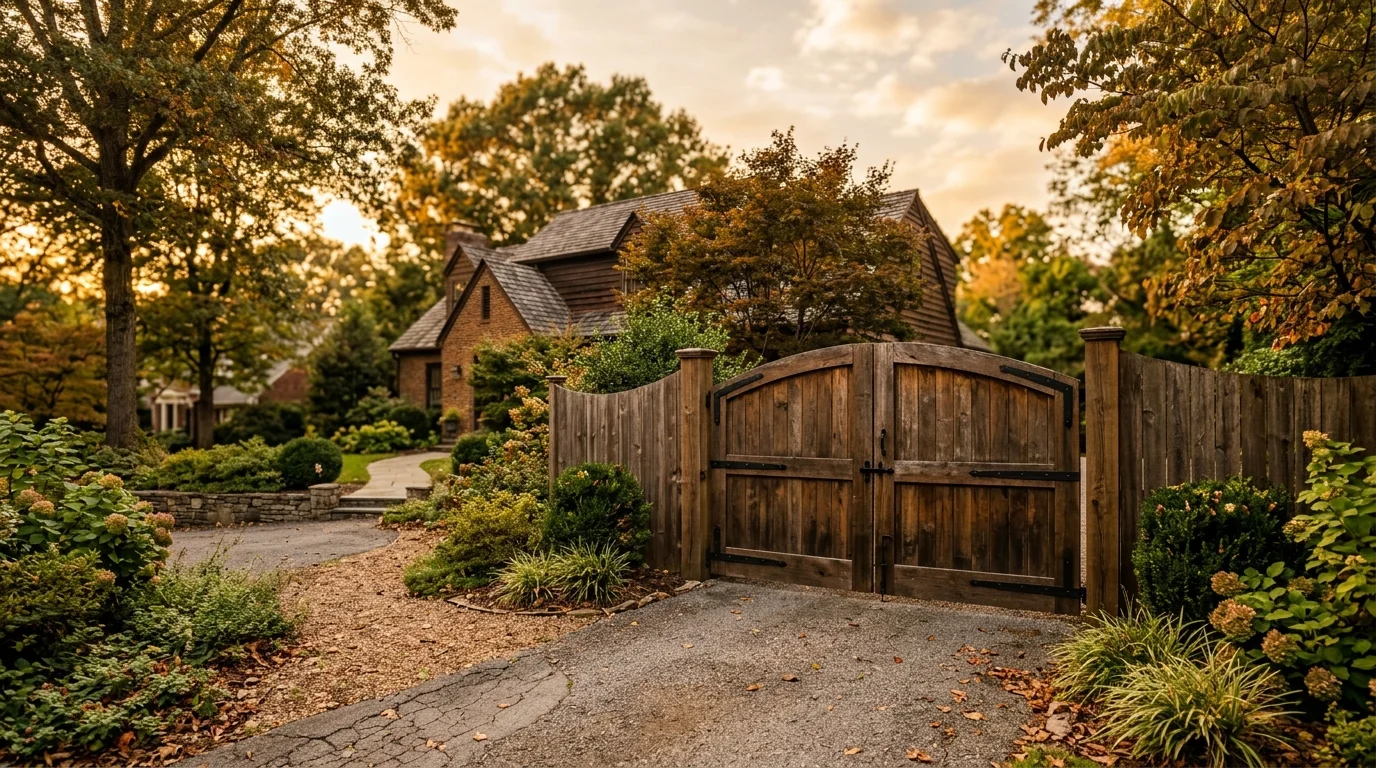
What is gate installation and when is it the right choice?
Gate installation is the process of setting dedicated posts, fabricating or sourcing a gate panel, and hanging that panel with hinges, a latch, and any self-closing or automated hardware the application requires. Unlike patching a failing gate or adjusting a hinge, full installation starts from a blank opening in a fence line. If no gate currently exists, if the existing opening lacks properly set gate posts, or if a homeowner is converting a pedestrian opening to a driveway entry, gate installation is the correct scope of work.
How it works mechanically
A gate is a cantilevered or hung panel that pivots on at least two hinges anchored to a dedicated post. Because the panel swings repeatedly and carries wind load, the posts it hangs from must be heavier gauge, set deeper, and embedded in larger concrete footings than standard line posts. The latch post on the opposite side must be equally solid. When either post moves even slightly out of plumb, the gate binds, drags, or fails to latch. Getting the post installation right is where gate jobs succeed or fail.
The conditions gate installation is designed for
Gate installation fits a specific set of conditions: a fence line with no existing entry point, an opening where prior posts have rotted or shifted too far to correct, or a project where the scope of the work is a full property fence with gates planned from the start. It also applies when a homeowner is upgrading from a simple walk gate to a double driveway gate or adding an automated operator, since those applications require post sizing and placement that an old single-gate opening rarely provides.
In Knoxville, Knox County’s Valley and Ridge clay soils add a layer of complexity. The shrink-swell cycles driven by the county’s roughly 47.9 inches of annual rainfall (NWS Morristown, KMRX, 1991-2020 Climate Normals) stress footings differently than dry-climate markets. Posts that look plumb at installation can drift over two or three seasons if the footing is undersized. That makes proper concrete encasement and footing diameter non-negotiable on local gate jobs.
When the alternative is the better choice
If the existing gate posts are plumb, solid, and set at adequate depth, a full reinstallation is unnecessary. Gate repair services for sagging or binding gates address hardware failure, frame racking, and hinge wear without disturbing the posts. Repair is typically a fraction of the installation cost and is completed in a few hours. The decision point is the condition of the posts. Sound posts, damaged panel or hardware: repair. Compromised posts or no existing gate at all: installation.
Installation process
Step 1: Site assessment and layout (Day 1 morning, 1-2 hours)
The installer marks the gate opening width, accounting for panel width plus hinge gap plus latch clearance. For a standard 4-foot walk gate, this means slightly more than 4 feet of clear opening between post faces. Driveway gates typically require 10 to 16 feet of clear span. The crew checks for underground utilities before any digging begins, either through Tennessee 811 (the state one-call notification service) or a private locate service.
Step 2: Post holes and footing pour (Day 1 midday, 2-4 hours)
Gate post holes are dug or augered to a minimum of 36 inches in standard Knox County residential soils. Ridge-position lots in West Knoxville and North Knoxville where shallow limestone bedrock is closer to the surface may require rock augering or a hammer drill attachment, which adds time. This Old House notes that post holes should reach at least 3 feet deep to get below the frost line, and gate posts warrant that depth as a minimum given the additional stress they carry. Posts are plumbed in wet concrete, braced, and left to cure. Most mixes reach working strength in 24 to 48 hours.
Step 3: Panel fabrication or delivery (concurrent with cure)
While concrete cures, the gate panel is either fabricated on-site from matching fence material or delivered pre-built. Wood gates for privacy fences are often built on-site to match board style, width, and picket height precisely. Aluminum ornamental gates, popular in Farragut and the Northshore communities of West Knox, typically arrive pre-welded from the fabricator and are hung once posts are set.
Step 4: Hanging the gate (Day 2 or late Day 1, 1-2 hours)
Hinges are fastened to the hinge post first, then the panel is lifted into position. Gate weight determines hinge count: most residential wood gates use two heavy-duty hinges, while gates over 200 pounds or 6 feet tall get three. The installer sets the reveal (gap between panel bottom and ground) at 2 to 4 inches for standard gates, or per local pool barrier code requirements when the gate is part of a pool enclosure. Latch hardware is installed, and the gate is swung several times to confirm smooth operation.
Step 5: Self-closing and self-latching hardware (pool and safety applications)
Pool enclosure gates must self-close and self-latch per CPSC and IRC requirements, which Knox County inspectors enforce. The U.S. Consumer Product Safety Commission specifies that gates should open outward from the pool and be self-closing and self-latching, with the latch positioned on the pool side so children cannot reach it from outside. Spring-loaded hinge sets or dedicated closer hardware accomplishes this and is typically installed in under an hour.
Step 6: Automated operator installation (optional, adds 4-8 hours)
Swing or slide gate operators require a power source, a control board, safety sensors, and either a keypad, remote receiver, or both. For swing gates, the operator arm is mounted to the hinge post and the panel. Concrete footpad work for slide gates adds another step. This scope is usually priced and scheduled separately from the basic gate installation.
Gate installation vs. gate repair
The choice between full gate installation and gate repair for hardware or frame issues comes down to what is still serviceable.
Gate repair is the faster and less expensive path when the hinge post and latch post are both plumb, set at adequate depth, and free from rot or concrete failure. A gate that sags, binds, or fails to latch is most often the result of worn hinges, a racked frame, or a latch mechanism that has corroded. Those failures are correctable in one to three hours without touching the posts. For most homeowners in Knox County whose gates are five to ten years old with no sign of post movement, repair is where to start.
Gate installation becomes necessary when the posts have shifted, when rot has compromised the post base below grade, or when the existing opening was never sized or reinforced for a gate at all. In Knoxville, the moderate-to-high shrink-swell activity in Knox County’s residual clay soils is a common cause of post drift over time. A post that has moved an inch out of plumb cannot be corrected by hardware adjustment alone. Resetting it properly means pulling it, re-digging or enlarging the hole, and re-pouring concrete.
Automated gate upgrades almost always trigger a full installation review. Swing operators impose torque loads on the hinge post that exceed what most fence line posts were designed to carry. Adding an operator to an underpowered post shortens the life of both the operator and the post. If automation is the goal, sizing the posts for that load from the start is the correct approach.
Gate installation cost in Knoxville, TN
According to Bob Vila, overall fence installation averages between $1,743 and $4,431 nationally, with gates representing a meaningful portion of that total when multiple entry points are involved. For standalone gate installation in the Knoxville metro, project costs typically range from $300 for a basic wood walk gate to $3,000 or more for a wide aluminum double driveway gate with automated hardware. Those figures align with the $1,900 to $5,800 average project range documented for Knox County residential fence work.
Several local variables push the number up or down:
Post depth and soil conditions. Ridge-position lots in North and West Knoxville where bedrock is closer to the surface require rock augering, which adds equipment time and sometimes a separate mobilization charge.
Gate width and panel weight. Walk gates (3 to 4 feet wide) are the least expensive. Double driveway gates spanning 12 to 16 feet require two heavy posts, larger footings, and more material.
Material. Pressure-treated Southern Yellow Pine remains the standard residential choice in Knox County. Aluminum ornamental gates, popular in Farragut and Northshore HOA communities, carry a higher per-unit cost but resist the moisture and ice loading that Knox County winters bring to wood frames.
Hardware upgrades. Self-closing hardware for pool enclosures, keyed locks, or automated operators each add to the total. Automation alone can add $800 to $2,500 depending on the operator type.
For a full project cost breakdown, see the gate installation cost guide for Knoxville.
Warranty and transferability
Gate hardware warranties vary more than fence warranties because they cover mechanical components (hinges, latches, operators) separately from structural work (posts and panel). A contractor providing a strong installation warranty should offer at least one year on labor and workmanship covering post plumb, concrete integrity, and hardware function. Quality hinge manufacturers often back their products for five years or more under normal residential use.
For automated gate systems, the operator manufacturer’s warranty typically runs one to three years on parts, with labor coverage shorter. Ask specifically whether the warranty covers labor cost to re-plumb a post that shifts within the first year, since that is the most common early failure mode in Knox County clay soils.
Transferability matters if you plan to sell. Some contractor warranties transfer to the next homeowner on written request; others do not. Ask for that confirmation in writing before the job starts. For pool enclosure gates where code compliance is required, confirm that the contractor will provide a written record of the hardware specifications so the next owner can demonstrate compliance without reopening the gate.
Permits and engineering
Permit requirements in the Knoxville area depend on which jurisdiction your property falls under.
City of Knoxville requires a permit for fences over 6 feet and for any fence or gate work in designated overlay districts or historic neighborhoods. Applications go through City of Knoxville Plans Review and Inspections. A gate added to an existing compliant fence generally does not trigger a standalone permit unless the overall fence height changes or the property is in an overlay district.
Town of Farragut applies its own permit and design review process through the Town of Farragut Community Development office. Farragut’s fence ordinances are notably stricter than Knox County’s standard code, and material and design approvals are often required before work begins. Gate replacements that change material, height, or style in Farragut typically require the same review as new fence installation.
Unincorporated Knox County requires a permit for structures over 6 feet, administered through Knox County Codes Administration and Inspections. Standard residential gates under 6 feet in height on non-flagged lots typically do not require a separate permit, but confirming with the office before work starts avoids problems.
Permit fees across these jurisdictions generally run $40 to $90 for residential fence and gate work.
Engineering is rarely required for a standard residential walk gate or even a double driveway gate. It becomes relevant when an automated gate operator is being installed, since the operator manufacturer may require a site drawing confirming post diameter, embedment depth, and footing size before the warranty is valid. In those cases, the installer typically provides a specification sheet rather than a stamped engineering drawing.
If your property is in a flood zone or on a lot with documented karst features, check with Knox County Codes before finalizing the design. Surface drainage interactions with Knox County’s limestone karst geology can affect footing design, and the county has documented sinkhole activity in parts of the Valley and Ridge terrain that can surprise homeowners in lower-lying areas.
Request a gate installation quote for your Knoxville property to get an accurate scope and cost estimate before scheduling any permit applications.
For properties outside the immediate Knoxville city limits, see the Knoxville metro service area page for coverage details and jurisdictional guidance on West Knox, North Knox, and surrounding communities.