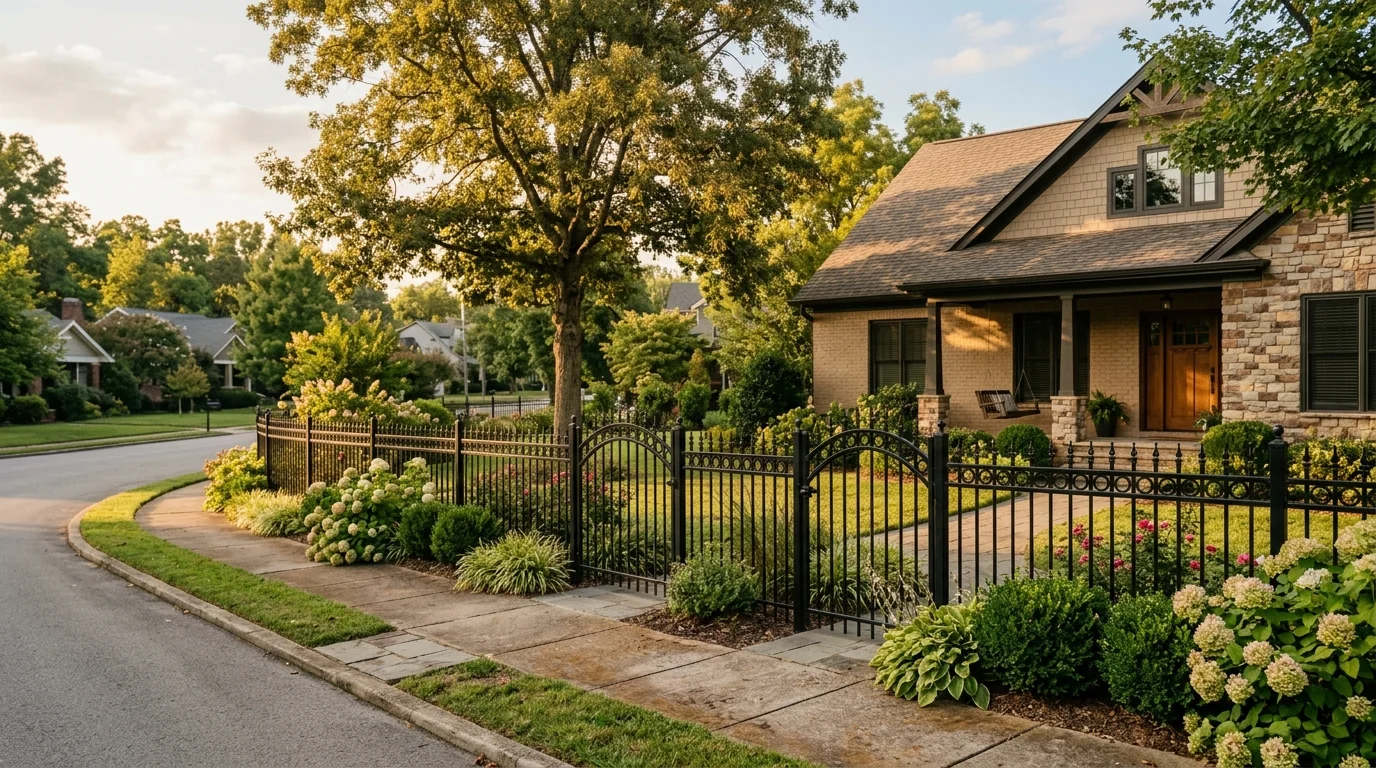
What is aluminum fence installation and when is it the right choice?
Aluminum fence installation is the process of setting powder-coated aluminum alloy posts into concrete footings and hanging pre-assembled panels between them to create a durable, low-maintenance perimeter around a residential or commercial property. In Knoxville, it is the standard choice for West Knox HOA communities, pool enclosures, and lakefront lots where ornamental styling is required and where the region’s roughly 47 inches of annual rainfall (NWS Morristown KMRX, 1991-2020 Climate Normals) would cause an uncoated steel or untreated wood fence to degrade within a few seasons.
How aluminum fencing works mechanically
Aluminum fence panels are fabricated from hollow alloy pickets welded or pressed into top and bottom rails. The alloy does not rust, so the powder-coat finish serves an aesthetic purpose rather than a corrosion-prevention purpose. Posts are typically 2x2 inches or 2.5x2.5 inches square and are set into concrete footings sized to local frost and soil conditions. Knox County’s residual clay soils (USDA Web Soil Survey, Knox County) have moderate-to-high shrink-swell potential, so posts set a minimum of 30 inches deep with an adequate concrete bell footing hold alignment through wet-dry seasonal cycles better than posts tamped in compacted gravel alone.
The conditions aluminum fencing is designed for
Aluminum fencing is the right call when a property needs a defined, attractive perimeter without a solid privacy wall. It performs well as a pool barrier (meeting the 48-inch minimum height required by the International Residential Code and the CPSC Safety Barrier Guidelines for home pools), as a front-yard accent fence, and as a boundary fence in West Knox lakefront communities like Northshore and Choto where HOA covenants specify ornamental metal. Because the material does not absorb moisture, ice loading during Knox County winters affects only the structural picket welds rather than the material itself, making aluminum more winter-durable than wood under those conditions.
When an alternative is the better choice
Aluminum is not the right material when solid privacy is the primary goal. The open picket design leaves full sightlines into the yard, which makes it a poor fit for homeowners whose top priority is shielding their yard from neighbors. In those cases, a vinyl or wood privacy fence installation is the more appropriate solution. Similarly, aluminum’s hollow-section construction is lighter than ornamental steel, which matters on commercial sites that need heavy-duty perimeter security. If budget is the overriding constraint and aesthetics are secondary, chain-link fence installation costs considerably less per linear foot.
Installation process
Aluminum fence installation follows a consistent sequence. The timeline below reflects typical conditions on a standard Knox County residential lot averaging around 155 linear feet.
Day 1, morning: Site layout and post-hole digging
The crew marks post locations at consistent spacing, typically 6 or 8 feet on center depending on the panel width specified. A gas- or electric-powered post-hole auger bores holes 30 to 36 inches deep into Knox County’s clay-dominant soils. On West Knox ridge-position lots where shallow bedrock is common, rock augering or a hammer-drill attachment may be needed. This is worth asking about in your initial quote. Total layout and digging time: two to four hours on a straightforward lot.
Day 1, midday: Post setting
Posts are plumbed vertically with a level, then concrete is poured around them. This Old House’s vinyl fence installation guide notes the importance of using a level to confirm the post is plumb before concrete sets, and the same discipline applies to aluminum installations. Crews typically brace posts with temporary stakes while concrete cures. Concrete achieves adequate working strength within four to six hours in warm weather, though full cure takes 24 to 48 hours.
Day 1, afternoon: Panel and rail installation
Once end and corner posts have initial set, pre-assembled aluminum panels slide between posts using concealed brackets or routed post channels. Panel alignment is checked against a string line to ensure consistent height across the run. Gates are hung last, with drop rods or self-latching hardware adjusted so the gate swings freely and latches without lifting. Pool barrier gates must be self-closing and self-latching under CPSC guidelines, so that hardware receives extra attention on pool enclosure projects.
Day 2 (if needed): Touch-up and cleanup
Any concrete overspill is cleaned from the post bases, excess soil from the post holes is removed from the site, and the crew does a final walk to check picket alignment and gate function. On projects over 200 linear feet or on lots with significant grade changes, a second day is normal. Knoxville’s valley-and-ridge terrain can put two sides of the same yard at different elevations, requiring racked or stepped panel transitions that add time.
Aluminum fence installation vs ornamental steel fence installation
The most common alternative to aluminum at the ornamental end of the market is ornamental steel. Both materials produce a visually similar product. The decision between them comes down to three practical factors: weight, rust resistance, and cost.
Aluminum is inherently rust-free because the alloy does not oxidize the way ferrous steel does. In a market with 47 inches of annual rainfall and humid summers like Knox County’s, that is a meaningful advantage. An ornamental steel fence with compromised or scratched powder-coat will begin to show surface rust at the scratch point within a season or two. Aluminum with a scratched finish will show bare metal but will not rust. For lakefront properties on the Tennessee River, in Choto, or near Fort Loudoun Lake, that difference is amplified by proximity to water.
Steel wins on rigidity and weight-bearing capacity. Solid steel posts and rails are stiffer under lateral load, which matters on commercial sites with security requirements or on properties that need a heavier physical deterrent. For residential applications in Knox County, however, the stiffness difference between a quality 14-gauge aluminum post and an ornamental steel post of comparable dimension is not meaningful in normal use.
On cost, Bob Vila’s fence installation cost guide puts aluminum at $17 to $90 per linear foot for material and labor combined, while wrought iron and ornamental steel runs $30 to $55 or more per linear foot. The wide aluminum range reflects the gap between builder-grade 16-gauge panels and premium commercial-grade products. Mid-range residential aluminum, the most common choice in West Knox HOA communities, typically falls in the $25 to $45 per linear foot installed range, though local terrain, access, and gate count all move that number.
If you need an ornamental fence and rust resistance is your top concern, aluminum is the stronger choice. If you need maximum rigidity, heavier commercial application, or prefer the weight and feel of solid metal, ornamental steel is worth pricing out. You can review how those two options compare side by side on our ornamental steel fence installation page.
Aluminum fence installation cost in Knoxville, TN
According to Bob Vila’s fence installation cost guide, the cost of an aluminum fence averages $17 to $90 per linear foot, with labor adding another $30 to $80 per hour. Applied to a 155-linear-foot project typical for Knox County residential lots, that produces a rough project range of roughly $2,635 to $13,950 before gates and permits. Most standard residential aluminum fence projects in this market land well below the top of that range.
Several local variables move the final number:
Panel grade and style. Residential-grade 16-gauge panels with flat-top pickets are the least expensive option. Commercial-grade panels with spear-top pickets and 13-gauge posts add cost but are often required by Farragut or West Knox HOA covenants.
Post depth and soil conditions. Lots with shallow bedrock on West Knox ridge positions require rock augering, which adds equipment time and crew hours to the post-setting phase.
Grade change and racking. Knoxville’s valley-and-ridge terrain means many residential lots require stepped or racked panel transitions. Each elevation change adds labor time and may require custom-cut panels.
Gate count and hardware. A standard single walk gate adds moderate cost. A double drive gate with self-latching pool hardware adds considerably more. Pool barrier projects often require two gates, each with CPSC-compliant self-closing hardware.
Access. Narrow side yards, mature landscaping, or fenced backyard access that prevents equipment entry increases post-hole digging time, since crews must use manual or electric augers in tight spaces instead of tractor-mounted equipment.
For a detailed breakdown of what moves aluminum fence costs in the Knoxville market, see the aluminum fence installation cost guide for Knox County.
If you are ready to price out your specific lot, request a local fence installation quote to get a site-specific number from a contractor familiar with Knox County’s soil and HOA conditions.
Warranty and transferability
A quality aluminum fence should carry at least a 20-year limited warranty covering powder-coat finish adhesion and structural defects in the panel and post material. Most reputable manufacturers in the residential ornamental market provide that coverage, with some extending a lifetime structural warranty on the aluminum alloy itself.
Before signing a contract, ask the installing contractor two questions. First, whose warranty covers what: the manufacturer covers material defects, but the installer should separately warrant labor and installation quality for at least one year, covering issues like post lean, concrete pop-out, or gate misalignment that develop within the first season. Second, whether the warranty is transferable. A transferable warranty adds documented value if you sell your Knoxville home, since the new owner can rely on the same coverage. In West Knox communities where resale value is a driving motivation for fence investment, transferability is worth confirming in writing before the project begins.
Powder-coat warranties typically exclude damage from impact, intentional abuse, or chemical contact. In Knox County, the more common warranty claim involves post lean caused by shrink-swell clay movement in years of extreme wet-dry cycling. A well-mixed concrete footing poured to adequate depth largely prevents that, which is one reason it is worth asking your contractor about footing diameter and mix ratio rather than just hole depth.
Permits and engineering in Knox County
Permit requirements for aluminum fence installation vary by jurisdiction within the Knoxville metro, and getting this wrong can mean forced removal or delays on sale.
City of Knoxville. A permit is required for any fence over 6 feet and for any fence in a historic overlay district, regardless of height. Contact the City of Knoxville Plans Review and Inspections division before breaking ground if your property is in an older neighborhood or near a designated historic corridor.
Town of Farragut. Farragut has notably stricter fence permitting and design review than either the City of Knoxville or unincorporated Knox County. Any fence, regardless of height, may be subject to design review under Farragut’s zoning ordinance. Contact the Town of Farragut Community Development office to confirm requirements before purchasing materials.
Unincorporated Knox County. A permit is required for fences over 6 feet. Contact Knox County Codes Administration and Inspections. Permit fees across all three jurisdictions typically run $40 to $90.
Corner lots. Setback rules differ between the City of Knoxville code, the Town of Farragut, and unincorporated Knox County. Corner-lot installations that feel straightforward often have a front-yard setback or sight-triangle restriction that limits fence placement. Confirm with the applicable office rather than assuming the same rule applies across the metro.
Pool barrier installations. Pool enclosure fencing triggers a separate inspection in all three jurisdictions. The fence must meet IRC pool barrier standards: minimum 48 inches measured on the pool-facing side, self-closing and self-latching gate hardware, and maximum 4-inch gap between pickets. An inspector will check these dimensions before issuing a final approval.
For fence damage that needs repair rather than a full new installation, see the fence repair services available in Knoxville for options on post correction and panel replacement.