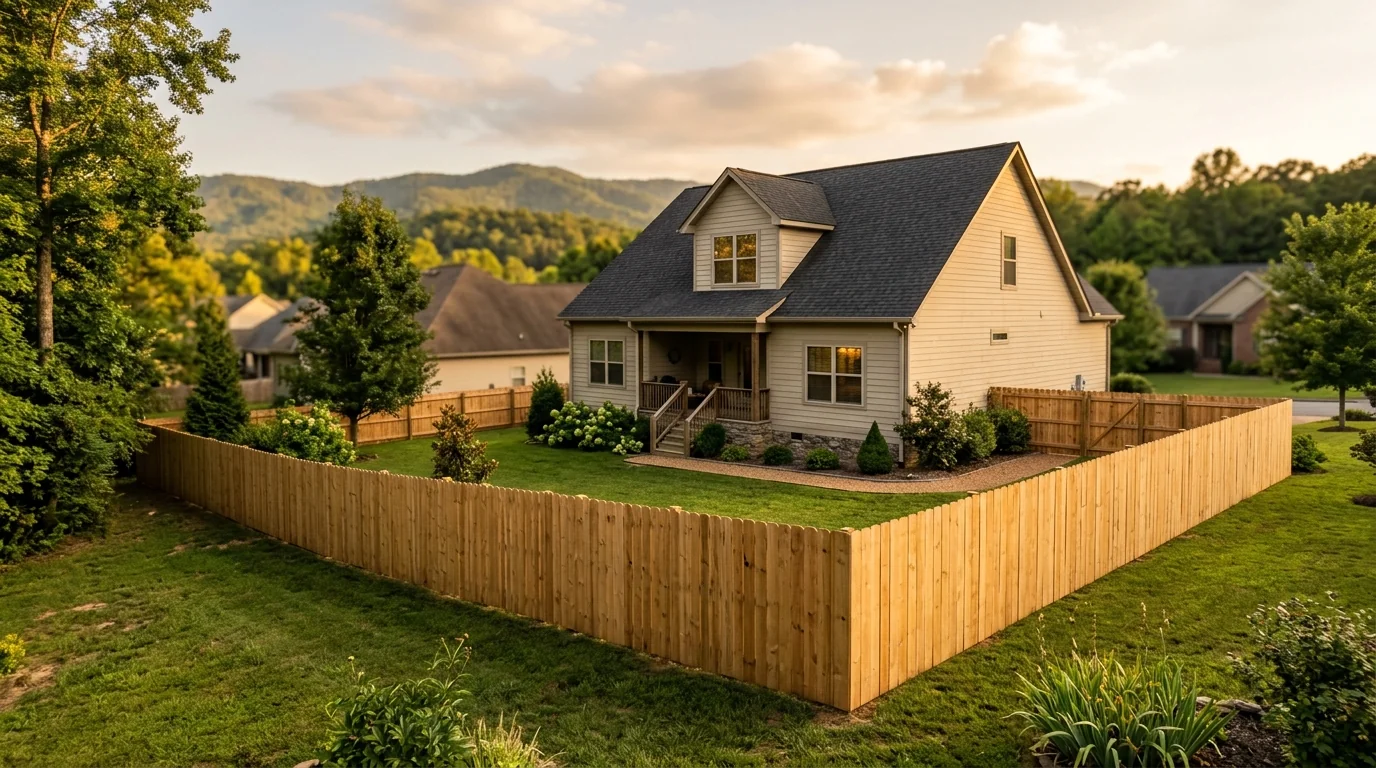
Service area · Tennessee
Fence installation in Seymour
Seymour is an unincorporated community split across Blount and Sevier counties in the Knoxville metro. Sloped terrain, silt loam soils, and a mix of older rural homes and newer subdivisions shape every fence project here. Getting the post depth and soil prep right from the start is what separates a fence that lasts from one that shifts and leans.
Typical foundation type: pier-and-beam
Why Seymour Fence Installation Is Different
Seymour sits at the edge of the Knoxville metro where suburban growth from two counties collides with older rural land patterns. As a census-designated place (CDP) straddling Blount and Sevier counties, according to Wikipedia, Seymour has no single municipal building department, which means permitting, setbacks, and code questions must go to two separate county offices depending on which side of the line your parcel falls on. That jurisdictional split is the first thing homeowners here need to understand before they ever call a contractor.
On top of that, the physical conditions in Seymour create real installation challenges. Sloped terrain, specific soil types, and a housing stock that ranges from mid-century farmhouses to brand-new subdivision builds means no two fence projects here are quite alike. Getting the details right at the estimate stage, before a post goes in the ground, is the difference between a fence that holds for decades and one that needs repair within a few seasons.
Soil and Geology in Seymour
USGS SSURGO data from the NRCS Soil Data Access service identifies two dominant soil series across Seymour parcels: Townley silt loam on 5 to 12 percent slopes and Dewey silt loam on slopes of 15 to 25 percent, both noted as eroded. These are not flat, stable building soils. Silt loam at those slope angles tends to compact unevenly, shed water quickly down the grade, and soften near drainage channels. For fence posts, that means backfill can shift seasonally as moisture moves through the profile. Posts set without adequate compaction or concrete collar work can begin to lean within two or three freeze-thaw cycles, even in a relatively mild East Tennessee winter.
The eroded condition of both series matters too. Eroded silt loam has lost much of its organic surface layer, which reduces its ability to bind around post material. Contractors who have worked Sevier and Blount county soils know to oversize post depth on any slope above 8 percent and to avoid relying on dry-packed fill alone on steeper runs.
Climate Considerations
East Tennessee sits in a humid subtropical zone with warm, wet summers and mild but occasionally hard winters. The Knoxville metro area receives meaningful rainfall distributed across the year, and Seymour’s sloped terrain channels that runoff directly through residential yards. Sustained rain events saturate the upper silt loam horizon quickly, temporarily weakening post anchorage. For wood fences, that repeated wet-dry cycle accelerates rot at the ground line unless boards and posts are pressure-treated to the appropriate retention level.
Summer humidity also affects vinyl and aluminum fences through thermal expansion. Panels installed with no room for movement can buckle or pop free of their brackets on consecutive 90-degree days. Experienced local contractors account for expansion gaps during installation rather than discovering the problem after the first summer.
Housing Era and Property Patterns
Seymour’s housing stock is genuinely mixed. Older parcels along highway corridors reflect East Tennessee’s agricultural past, with large lots, irregular boundaries, and fence lines that sometimes run hundreds of linear feet across uneven ground. Newer subdivisions that filled in during the 2000s and 2010s sit on graded pads with tighter lot lines and HOA covenants that specify material and height restrictions. A contractor quoting a Seymour job needs to ask upfront which type of property they are visiting, because the site conditions, linear footage, and code context are fundamentally different.
Seymour Neighborhoods and Fence Patterns
Seymour does not have formal named neighborhoods in the way an incorporated city would. The following districts reflect the community’s real geographic and housing character, based on the area’s road corridors and development patterns.
- Boyds Creek Highway Corridor. A mix of small subdivisions and commercial-adjacent residential lots. Fence demand here skews toward privacy wood and vinyl from families in newer construction.
- Chapman Highway Area. One of Seymour’s main arterials, with residential density increasing closer to the Knoxville line. HOA-governed subdivisions are more common here and often restrict fence height to 6 feet.
- Little Pigeon River Corridor. Rural residential parcels near the river face the most drainage complexity. Fence lines here often cross seasonal wet areas, requiring treated posts and potentially concrete footings rather than compacted fill.
- Kodak Road Area. Transitional zone between Sevier County agricultural land and suburban buildout. Lot sizes are larger, meaning longer fence runs and more exposure to slope variation.
- Bogard Road District. Older residential development with a mix of pre-1980 homes and infill construction. Pier-and-beam foundations are more common here, and fence planning near structures needs to account for crawl-space access.
- Seymour Road Subdivisions. Planned subdivisions with platted lots and recorded covenants. Setback requirements from plat documents, not just county code, govern fence placement.
- Old Knoxville Highway Area. Legacy corridor with long-established residential properties. Boundary disputes are more common on older platted lots without recent surveys.
- Tuckaleechee Pike Neighborhoods. Semi-rural character with generous lot depth. Chain-link and split-rail fencing remain common for agricultural boundaries and dog containment on larger parcels.
How to Find a Seymour Fence Installation Contractor
The Knoxville metro has no shortage of fence contractors, but Seymour’s specific conditions narrow the field of contractors who will do the job well the first time. Four criteria matter most here.
Warranty terms in writing. A warranty that covers both materials and labor is the minimum standard. Ask specifically whether the warranty addresses post movement on sloped lots. A contractor who hedges on slope-related movement, or who excludes it from coverage, is signaling that they are not confident in their installation method on Seymour terrain.
County-specific permit knowledge. Because Seymour spans Blount and Sevier counties, a contractor should be able to tell you immediately which county office governs your parcel and what the current height and setback requirements are. A contractor who gives the same generic answer regardless of which county you are in has probably not pulled permits in this specific area recently.
Local-experience specificity. Ask the contractor to describe a recent project on a sloped lot in either Blount or Sevier County. They should be able to reference soil conditions, how they handled the grade change between panels, and what post depth they used. Generic answers about doing “lots of jobs in the area” are not a substitute for actual terrain-specific experience.
Diagnostic discipline before quoting. A trustworthy contractor walks the fence line, measures slope, checks for buried utilities, and identifies drainage patterns before generating a quote. A contractor who quotes a Seymour job by linear foot over the phone, without a site visit, is skipping the variables that most affect final cost and quality. Request a free on-site assessment before committing to any estimate.
What to Expect from a Seymour Fence Inspection
A thorough pre-installation inspection in Seymour should cover four areas.
Exterior walk-around. The contractor walks the entire proposed fence line, checking slope percentage at each panel run, identifying any existing encroachments, and noting proximity to utility easements. On Townley or Dewey silt loam at grades above 10 percent, this step determines whether racking, stair-stepping, or a combination is the right approach.
Soil condition assessment. The installer should probe or test-dig at representative points along the line, not just at the corner posts. Silt loam that has been eroded loses cohesion faster than undisturbed soil, and a contractor who skips this step may set posts at a depth appropriate for flat, stable ground but inadequate for Seymour’s hillside conditions.
Drainage and wet-area identification. Low points along the fence line, especially near the Little Pigeon River corridor or in drainage swales between lots, need special attention. Posts in consistently wet soil need deeper concrete collars, and the bottom rail gap should be sized to allow debris to pass rather than dam water against the fence.
Boundary and plat review. On older Seymour properties, the recorded lot lines may not match the visible grade or an existing fence line. The inspection should include a conversation about when the property was last surveyed. Installing a new fence on an assumed boundary without survey confirmation is one of the more common sources of neighbor disputes in unincorporated areas. Nolo’s legal overview of fence boundary disputes is a useful reference for understanding your rights and obligations before a post goes in the ground.
Repair Methods and Fence Types Used Most Often on Seymour Homes
Seymour homeowners choose fence types based on the same drivers found across the Knoxville metro: privacy, pet and child containment, and property definition. The sloped terrain and larger rural lots also create demand for longer agricultural-style fence runs. Costs cited here come from Bob Vila’s fence installation cost guide.
- Wood privacy fence. The most common choice for suburban subdivisions. Installed cost runs $27 to $60 per linear foot for privacy-height boards, per Bob Vila’s wood fence cost guide. On sloped lots, contractors stair-step or rack the panels. Total project cost typically falls between $1,763 and $4,416. See wood fence installation options in the Knoxville area for more detail.
- Vinyl privacy fence. Popular with homeowners who want low-maintenance performance. Vinyl runs $15 to $40 per linear foot in materials, with installed costs averaging $2,292 to $5,799 nationally, per Bob Vila’s vinyl fence cost guide. Thermal expansion is a real consideration on sun-exposed south-facing slopes.
- Chain-link fence. Common on larger rural parcels and for dog runs. Bob Vila puts installed cost at $15 to $30 per linear foot, making it the most cost-accessible option for long agricultural fence lines. See full fence cost comparisons for a side-by-side breakdown.
- Split-rail fence. Used on rural and semi-rural parcels for boundary definition and aesthetic framing. Bob Vila prices split-rail at $12 to $30 per linear foot. The open design handles slope well because there are no solid panels to rack or step.
- Aluminum ornamental fence. Common in higher-end subdivisions where HOA rules favor a decorative look over full privacy. Bob Vila lists aluminum at $17 to $90 per linear foot depending on style, with labor adding $30 to $80 per hour.
For repair needs on existing fences, including post replacement and panel repair after storm damage, see the fence repair services page.
Seymour Building Permits
Seymour is an unincorporated CDP with no municipal government of its own. Permit jurisdiction falls to the county, and because Seymour spans Blount and Sevier counties, the right office depends entirely on your parcel’s recorded county.
For parcels in Blount County, fence permits are handled through Blount County Planning. Height limits, setback requirements from property lines and easements, and subdivision plat covenants all apply. Blount County follows the Tennessee State Building Codes program, which adopts the International Building Code family with state amendments. For parcels in Sevier County, Sevier County Building and Codes administers permits. Sevier County has seen rapid residential growth toward the Gatlinburg and Pigeon Forge corridors, and its codes office processes a significant volume of residential work.
In both counties, a fence permit is typically required when the fence exceeds a specified height (commonly 6 feet) or when it is located within a certain distance of a right-of-way. Pool enclosure fences have their own requirements. The U.S. Consumer Product Safety Commission recommends that pool barriers be at least 48 inches above grade on the outward-facing side and that gates be self-closing and self-latching, per CPSC Publication 362. Always confirm current requirements with the relevant county office before installation begins, since code adoptions and local amendments change.
Homeowners in recorded subdivisions should also check their HOA covenants before applying for any permit. HOA restrictions on material, color, height, and style often go beyond what the county requires and are enforced independently of the permit process.
Other Tennessee Cities Served
Seymour sits at the heart of a network of communities the brand serves across the Knoxville metro. If your project crosses county lines or you are comparing contractors across nearby areas, these pages cover the same detail for neighboring markets.
- Fence installation in Knoxville, TN covers the metro’s urban core, including permitting through Knoxville’s city codes office and the range of neighborhood conditions from older Fourth and Gill-era homes to newer West Knoxville subdivisions.
- Fence installation in Rockford, TN focuses on the Blount County corridor directly south of Seymour, where terrain and soil conditions closely parallel what Seymour homeowners encounter.
- Fence installation in Alcoa, TN serves a neighboring incorporated city in Blount County with its own building department and a dense mix of mid-century and contemporary residential construction.
Neighborhoods served
Seymour neighborhoods
- Boyds Creek Highway Corridor
- Chapman Highway Area
- Little Pigeon River Corridor
- Kodak Road Area
- Bogard Road District
- Seymour Road Subdivisions
- Old Knoxville Highway Area
- Tuckaleechee Pike Neighborhoods
Questions
Seymour fence installation FAQs
Why do fences in Seymour shift or lean after just a few years?
How much does a wood privacy fence cost in Seymour?
Do Seymour homeowners need a permit to install a fence?
How do I find a fence contractor with real experience in Seymour?
What neighborhoods or areas in Seymour tend to have the most fence activity?
Can a contractor inspect my Seymour property for free before giving a quote?
What foundation type is most common under Seymour homes, and does it affect fencing?
Free inspection
Free Seymour fence estimate
On-site elevation survey, written quote within 24 hours, no obligation.