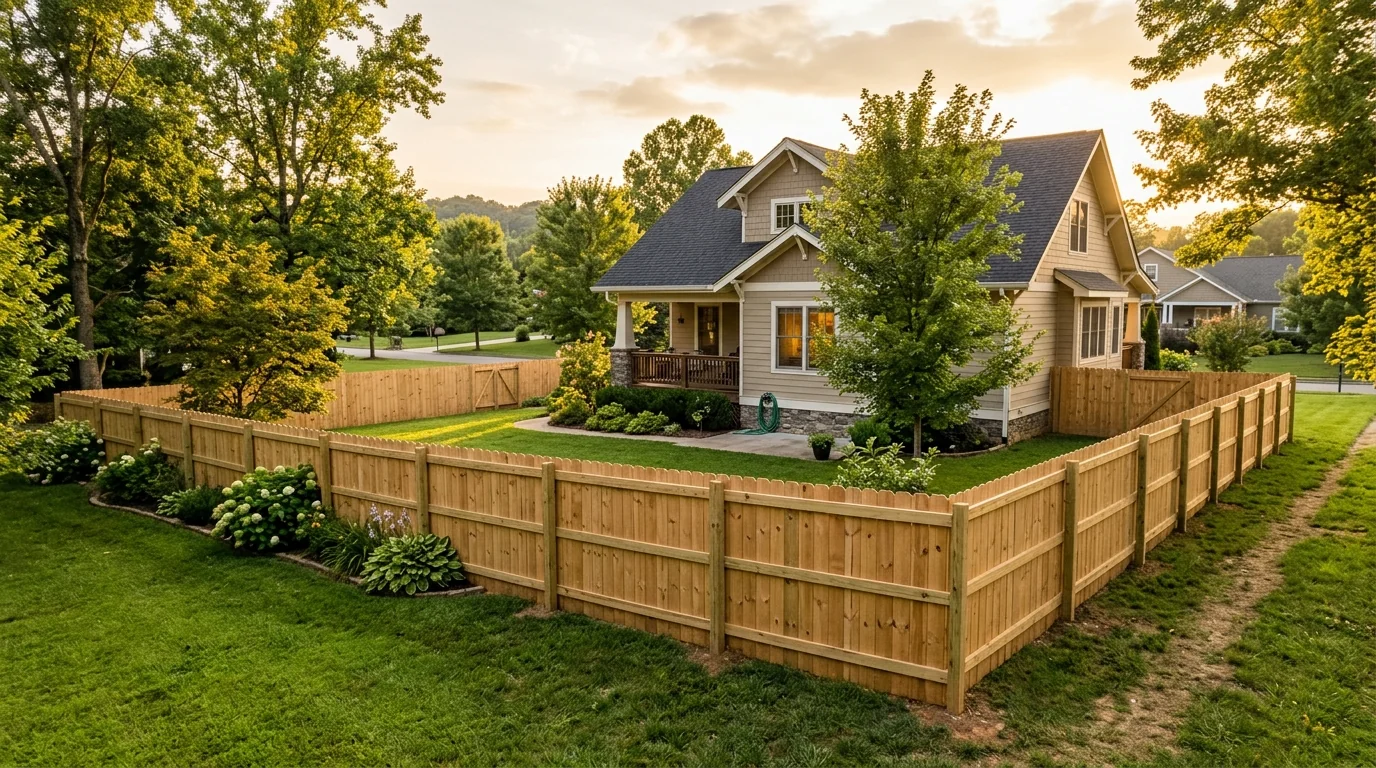
HOA Fencing Rules in Knoxville TN What You Need to Know
HOA fencing rules in Knoxville typically cap privacy fence height at 6 feet, restrict front-yard fencing, and require pre-approval for materials and colors. The Town of Farragut enforces stricter design standards than the rest of Knox County. Getting approval in writing before installation prevents costly removal orders.
Updated Jul 14, 2025 · 7 min read
HOA fencing rules in Knoxville, Tennessee typically limit privacy fence height to 6 feet, restrict or ban front-yard fences, specify approved materials, and require written approval from an architectural review committee before a single post goes in the ground. The Town of Farragut adds a second layer of design review on top of any HOA restrictions. Skipping either process can result in a forced removal order, and the cost of tearing out an unapproved fence falls entirely on the homeowner.
Why HOA Rules and Government Permits Are Two Different Things
This is the single most common source of expensive mistakes. A fence that passes Knox County code inspection can still violate your HOA covenants, and vice versa. The two approval systems operate independently and neither one waives the other.
Government permits in Knox County cover structural safety and setbacks. For most residential fences at or under 6 feet, the City of Knoxville and unincorporated Knox County require a permit only in specific circumstances, such as fences in historic overlay districts or those that exceed 6 feet in height. Permit fees typically run $40 to $90 (Knox County Codes Administration and Inspections). The Town of Farragut is a separate municipality with its own permitting process through Farragut Community Development, and it enforces design standards that go well beyond basic safety code.
HOA approval, by contrast, comes from your neighborhood’s architectural review committee (ARC). It focuses on aesthetics, materials, height, and placement. Most Knox County HOA covenants require you to submit a written request that includes a site plan showing the fence location, the proposed height, and a material or color sample. The ARC typically has 30 to 45 days to respond, depending on the covenant language.
Start with the HOA process first. If the ARC rejects your plan, you will need to revise before investing time in permit applications.
What Knox County HOA Covenants Usually Restrict
While every HOA document is different, the most common fence restrictions across Knoxville-area neighborhoods follow a recognizable pattern:
Height limits. Most Knox County HOA covenants cap rear and side yard privacy fences at 6 feet. Front-yard fences are often capped at 4 feet, and in many West Knox planned communities they are prohibited entirely.
Approved materials. Pressure-treated Southern Yellow Pine, aluminum ornamental, and vinyl are the materials most frequently listed as acceptable. Chain-link is commonly prohibited in front yards and sometimes banned outright in planned communities, particularly those in Hardin Valley and along Northshore.
Finished side orientation. Many covenants require that the finished or “good” side of a wood fence face outward toward neighbors and the street.
Color and finish. Natural wood stain, white vinyl, and dark bronze aluminum are standard approvals. Bright paint colors or stains not matching the neighborhood palette often trigger rejection.
Setback from property lines. HOA setback rules may be stricter than city or county setbacks. Some covenants require a fence to sit 2 to 4 feet inside the property line even if the city code would allow placement at the line.
Knoxville’s High-HOA-Density Zones
HOA density in Knox County is moderate overall, but it is heavily concentrated in specific areas. If you live in one of these communities, expect both stricter rules and more active enforcement:
Farragut (West Knox County) has the highest HOA density in the metro and is the only area where a separate municipal design review layer applies on top of HOA covenants. Farragut’s Community Development office reviews fence applications for design compatibility, not just safety compliance. Aluminum ornamental fencing is common here because it tends to satisfy both the town’s standards and HOA aesthetics simultaneously.
Hardin Valley includes newer West Knox subdivisions built over the past 15 years. HOA covenants in these neighborhoods were written recently and tend to be detailed, with material lists and color palettes explicitly spelled out.
Northshore and Choto are West Knox lakefront communities where aluminum ornamental is the dominant approved style. Wood privacy fences along the lakefront are frequently restricted or required to be set back from the shoreline.
Karns and Powell contain a mix of older rural lots and newer planned subdivisions. Restrictions vary significantly from one neighborhood to the next, so verifying your specific HOA documents matters more than assuming a neighborhood-wide standard.
The Local Climate Adds a Material Consideration
Knoxville receives an average of 47.9 inches of rainfall annually (NWS Morristown, KMRX, 1991-2020 Climate Normals). That moisture, combined with Knox County’s clay soils derived from weathered limestone and shale, creates wet-dry shrink-swell cycles that stress fence posts year over year (USDA Web Soil Survey, Knox County). Wood fences on poorly drained lots can develop post rot faster than homeowners expect.
Ice loading is a bigger concern in Knox County than tornado wind load. Ice accumulation on fence panels and on tree limbs overhanging a fence line causes winter damage across the metro, particularly for wood and chain-link fences with vegetation growing through them.
If your HOA approves vinyl or aluminum, both materials handle ice loading better than wood and eliminate the rot concern on wet lots. If wood is your preference or your HOA’s stated standard, pressure-treated Southern Yellow Pine is the regional default for a reason: it handles the moisture cycling better than untreated pine or cedar brought in from outside the region.
For more on how material choice affects long-term costs, the fence installation materials and options guide covers the tradeoffs in detail.
Corner Lots and Sight-Line Rules
Corner lots in Knox County face a distinct set of complications. The City of Knoxville, Town of Farragut, and unincorporated Knox County each have different corner-lot setback and sight-triangle rules. On top of those, HOA covenants may impose their own sight-line restrictions to maintain neighborhood visibility at intersections.
If your lot sits on a corner, confirm requirements from both your governing municipality and your HOA before submitting any ARC application. A fence that a county inspector would pass can still trigger an HOA violation notice if it reduces the sight triangle the covenant is designed to protect.
Pool Fencing Is Non-Negotiable
If you are adding a pool fence or enclosing an existing pool, a separate set of rules applies regardless of your HOA status. Knox County requires pool barriers to meet International Residential Code minimums, which align with CPSC guidelines: the top of the barrier must be at least 48 inches above grade on the side facing away from the pool, and gates must be self-closing and self-latching (CPSC Publication 362). The CPSC notes that many of the nearly 300 children under 5 who drown each year in backyard pools could be saved by complete pool enclosures with self-latching gates.
Your HOA may add height or style requirements on top of that baseline. Both approvals, government permit and HOA sign-off, are required before installation.
What This Means for Your Project
HOA fence rules add time to any installation project, typically two to six weeks for the ARC approval cycle. Build that buffer into your schedule before contacting contractors. Arriving at the first contractor conversation with your HOA covenants in hand, or at least knowing which HOA you belong to, lets an installer give you an accurate quote the first time rather than a placeholder that changes after the review.
Material selection often narrows significantly once you read your covenants. Knowing that your HOA only approves aluminum ornamental or white vinyl before you visit a showroom saves time and prevents the frustration of falling in love with a fence style that your ARC will reject.
Once you have approval in hand, understanding the full fence installation cost in Knoxville helps you compare contractor quotes accurately and spot anything that looks out of line.
Ready to move from research to a real number? Request a fence installation quote for your Knoxville property and bring your HOA approval documents to the first conversation.
Free written quote
Planning a fence? Get a free quote.
On-site measure and a written quote within 24 hours. No obligation.
Questions
HOA Fencing Rules in Knoxville TN What You Need to Know FAQs
Do I need HOA approval before installing a fence in Knoxville?
What is the maximum fence height allowed by most Knoxville HOAs?
Does the Town of Farragut require a fence permit?
What fence materials do Knoxville HOAs typically approve?
Do HOA rules apply on top of city or county fence permits?
Can my HOA require me to remove a fence that is already built?
What are the pool fence requirements in Knoxville?
Free quote
Talk to a Knoxville fencing pro
On-site measure and a written quote within 24 hours. No obligation.