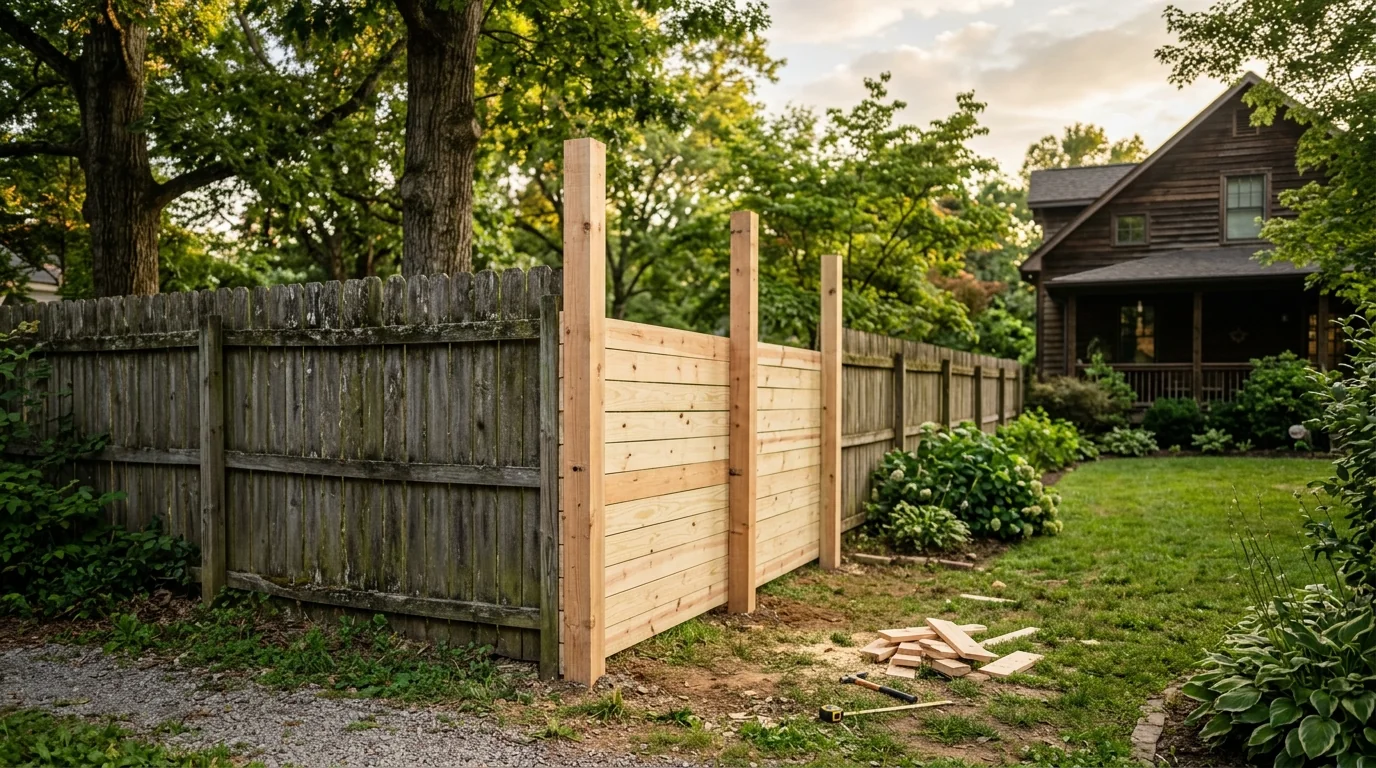
Fence Post Replacement in Knoxville, TN: What a Failing Post Tells You and What to Do About It
Fence post replacement is the most common structural repair Knoxville homeowners face, and it is also one of the most frequently delayed. A post that leans a few inches looks like a cosmetic problem. It is not. Every post carries the load of the panels on either side, and once one fails, lateral stress transfers to neighboring posts and rails, starting a slow chain reaction that can bring down an entire fence run before a homeowner realizes what is happening.
What This Symptom Looks Like (and When to Act)
Exactly what a failing fence post looks like
The most obvious sign is visible lean, any post that has shifted more than a few degrees from plumb. Beyond lean, look for posts that rock or wobble when pushed by hand, gaps between the post base and surrounding soil, wood that feels spongy or crumbles when you press a screwdriver into it, dark staining or mushroom growth at or below the soil line, and fence rails that have pulled away from the post or cracked at the attachment point.
Sometimes the panel itself sags or bows between two posts, which indicates a post has lost its footing underground even if it has not visibly leaned yet.
When to monitor vs. when to act now
If a post shows very slight surface weathering but is still firmly anchored in the ground with no soft wood and no lean, monitoring through one full wet season is reasonable. Take a photo of the post against a straight reference point and check it again after a heavy rain cycle.
If the post is leaning, rocking, or has soft wood at the base, treat it as an act-now situation. Knoxville receives an average of 47.9 inches of rain per year (NWS Morristown, KMRX, 1991-2020 Climate Normals), and each wet cycle accelerates rot in compromised wood. A post that is 60 percent rotted at the base can fail suddenly under wind load or the weight of a child or pet pushing against the panel.
What NOT to do
Do not pack fresh soil or gravel around a leaning post and call it fixed. Doing so traps moisture and accelerates rot at exactly the point where the post is already weakest. Do not sister a board to the outside of a rotted post without addressing the buried section, because the original footing is still failing underground. Do not wait until an entire fence section falls before calling for an inspection, since at that point the fence boards, rails, and adjacent posts often need replacement as well.
What Causes Fence Post Failure in Knoxville, TN
Knox County’s soils are primarily residual clay and silty clay derived from weathered limestone, dolomite, and shale in the Valley and Ridge province (USDA Web Soil Survey, Knox County, Tennessee). These soils have moderate-to-high shrink-swell potential. During dry summers they contract and pull away from post bases. During wet winters and spring seasons they expand and push against posts. This repeated movement works posts loose from their concrete footings over years, especially when the original footing was undersized.
Valley-and-Ridge terrain in Knox County concentrates stormwater runoff into low-lying yard positions. A home at the base of a grade in neighborhoods like Powell or Karns may have soil around its fence posts that stays saturated for days after a heavy rain, while a ridge-top property dries out quickly. This drainage difference explains why two homes with the same fence age can have very different post conditions.
Ice loading is a separate and underappreciated factor. Knox County sees more frequent ice accumulation events than metro areas further south in Tennessee. Ice on fence panels and on any vegetation growing on or near the fence adds substantial downward and lateral weight, levering posts out of alignment. This Old House notes that posts should be confirmed plumb during installation, but ice loading after installation can undo that alignment gradually over multiple winters.
Remnants of Hurricane Helene in September 2024 caused widespread saturation and tree failures across East Tennessee, with Knox County experiencing significant wind and ground saturation. Many post failures visible in late 2024 trace directly to the extended soil saturation from that event, which softened the clay around footings and allowed previously marginal posts to shift.
Repair Methods That Address Failing Fence Posts
Full fence post replacement with concrete reset
The most thorough approach involves removing the failed post, breaking out or extracting the old concrete footing, and setting a new pressure-treated post in a fresh concrete pour. Pressure-treated Southern Yellow Pine is the standard residential material in Knoxville and holds up well in the region’s clay soils when properly installed. The new post should be set 30 to 36 inches deep to anchor below the local freeze depth and into stable subsoil. This method is appropriate when the post has active rot at or below the soil line.
See the full scope of this approach on the fence post replacement service page.
Post resetting without full replacement
When a post has pulled out of its footing due to soil movement but the wood itself is structurally sound, a contractor can plumb the post, add fresh concrete around the base, and brace it while the concrete cures. This approach costs less than full replacement and is appropriate for posts that lean due to original footing failure rather than wood decay. It is not a long-term solution for a post with any rot present at the base.
Section-level fence repair
Sometimes a failing post has damaged the rails and boards attached to it. In that case, replacing the post alone leaves warped or cracked fence boards that will accelerate further failure. A section-level repair replaces the post and the immediately affected fence boards and rails as a unit, restoring both structure and appearance. This approach is common in Knoxville privacy fence repairs where the boards have absorbed water from a failing post over several seasons.
Explore how section repairs work on the fence repair service page.
For homeowners whose fence has multiple failing posts across a long run, a full privacy fence installation may be more cost-effective than piecemeal repairs. A contractor can assess whether the remaining posts are worth keeping during a free inspection.
Typical Cost Range
According to Bob Vila, wood privacy fence material costs $27 to $60 per linear foot, and fence installation labor runs $30 to $80 per hour. Single-post replacement involves concrete removal, a new post, fresh concrete, and labor to re-attach the fence boards, so expect the labor component to be the larger share of the bill on a one- or two-post repair.
For larger fence repair and replacement projects, the fence cost guide breaks down material and labor costs by fence type and project size, which helps Knoxville homeowners evaluate quotes and understand what they are paying for.
What a Free Inspection Looks For
A thorough fence post inspection covers more than just the obviously leaning posts. A good inspection process includes:
Probing every post at the soil line with a pointed tool to test for soft wood, which reveals rot that is not yet visible on the surface. Pushing each post by hand to test for movement, since a post that rocks even slightly has lost its footing connection. Measuring the lean angle of any visibly off-plumb post against a level, and checking whether the lean is worsening in one direction (which suggests soil pressure from drainage) or random (which suggests rot-driven failure). Examining fence rails at the post connection points for cracking or separation, and checking fence boards for warping that indicates moisture coming from a saturated post.
In Knox County’s karst limestone areas, an inspector should also note whether any section of yard shows unusual settling or low spots that could indicate subsurface drainage issues affecting the fence post footing zone.
After the walkthrough, a written summary should identify which posts are act-now failures, which are borderline monitor situations, and which are in good condition. That documentation lets homeowners prioritize repairs and get accurate quotes.
Get a no-obligation assessment by requesting a free fence inspection and quote.
When to Skip Repair (or Wait)
Not every leaning post is an emergency. A post that leans very slightly, shows no rot, and is still firmly anchored in the ground may warrant a re-check in six months rather than immediate replacement. Taking a baseline measurement and photograph now gives you something to compare against.
Posts on decorative fences with no containment function (a low picket fence bordering a garden bed, for example) carry lower risk from delayed repair than posts on a six-foot privacy fence containing children or dogs. Factor in what the fence is actually doing before deciding how urgently to act.
If your fence is already 15 or more years old and has three or more failing posts across a 150-foot run, a full fence repair assessment often reveals that replacement is more economical than spot-treating each post individually. A contractor can help you run those numbers during the inspection visit.