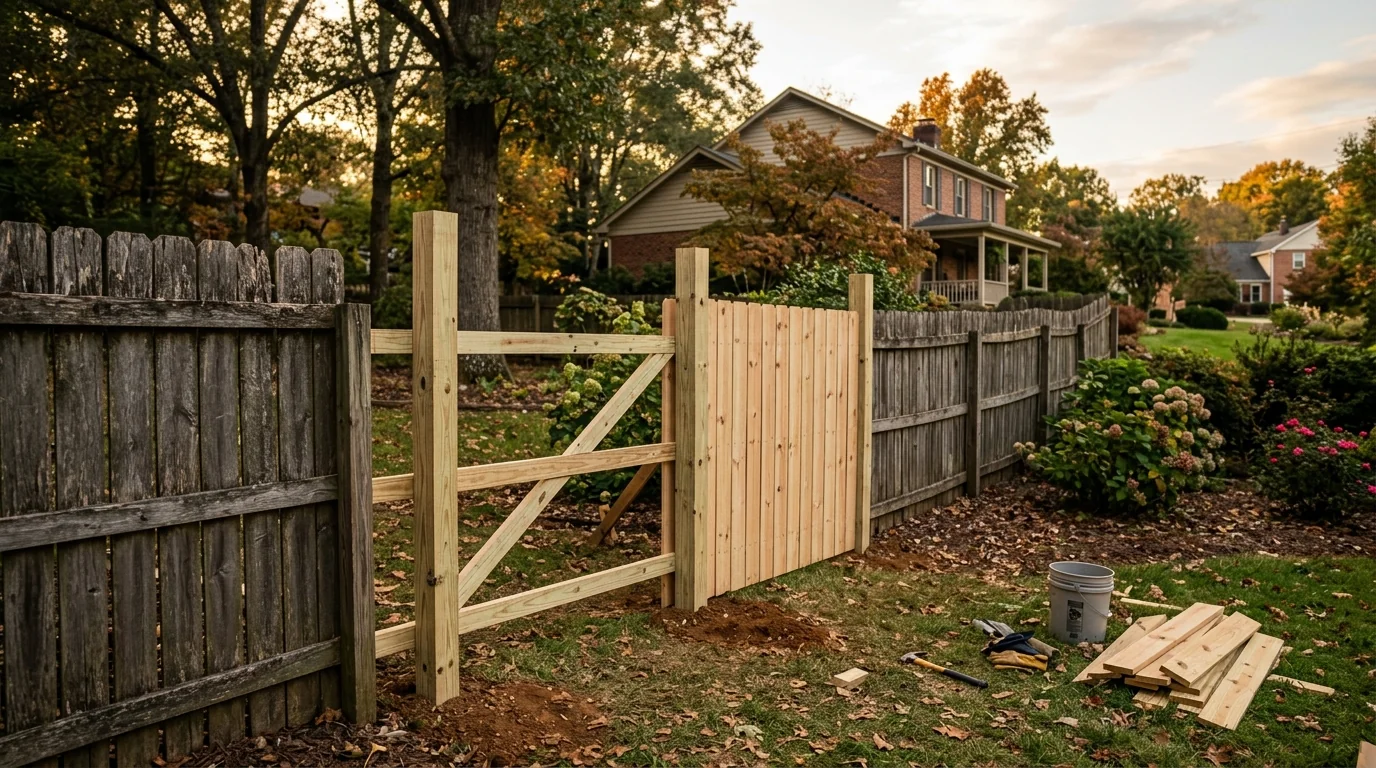
Storm-Damaged Fence Repair in Knoxville, TN
What This Symptom Looks Like (and When to Act)
A storm can change a fence from a solid boundary to a liability in a matter of hours. Recognizing the type and extent of damage quickly helps you decide whether this is a watch-and-wait situation or one that needs a contractor on-site this week.
What Storm Fence Damage Looks Like Exactly
The most obvious sign is a post that has snapped at or just below grade, leaving the upper section of fence leaning at an angle or lying flat. Related signs include pickets or panels blown completely free of their rails, rails split or knocked out of their brackets, and gates that no longer close because the hinge post has shifted. After ice storms, you may see panels still in place but bowed inward or outward under residual ice weight, or picket tops sheared off where a limb fell across the fence line.
Less obvious damage includes posts that look upright but rock when pushed, concrete footings that have heaved slightly from frost or saturated soil, and small cracks at the base of vinyl panels where impact stress concentrated.
Monitor vs. Act Now
Act now if: a post is snapped, the fence line has dropped or shifted, any section has fallen into a neighbor’s yard or a public right-of-way, or the fence borders a pool or contains young children and pets. A gap in a pool barrier fence is a safety emergency regardless of how small it looks.
Monitor if: damage is limited to one or two cracked pickets with no structural post movement, the fence line remains plumb, and the gap created is too small for a child or pet to pass through. Photograph the damage dated, measure any lean, and recheck after the soil firms up.
What NOT to Do
Do not nail a fallen panel back to a snapped post and call it repaired. A fractured post below grade carries no load and will fail again in the next windstorm. Do not fill a cracked vinyl panel with caulk as a long-term fix. Do not wait months to address exposed wood end-grain at a break point, moisture wicks in fast, and rot accelerates from that point outward.
What Causes Storm Fence Damage in Knoxville, TN
Knox County sits in the Valley and Ridge province, where residual clay and silty clay soils derived from weathered limestone and shale dominate (USDA Web Soil Survey, Knox County, Tennessee). These soils have moderate-to-high shrink-swell potential. After the region’s 47.9 inches of average annual rainfall (NWS Morristown, KMRX, 1991-2020 Climate Normals), the clay around fence posts becomes saturated and loses much of its lateral grip. A post set in firm soil may hold through a 60 mph wind gust; that same post in water-logged clay after two days of rain has far less resistance and snaps or pulls free at the base.
Knox County experiences one to three tornado events per year on average (NWS Storm Prediction Center archive), lower than the open terrain of Dixie Alley to the southwest, but straight-line wind damage from thunderstorm complexes and remnant tropical systems is a regular occurrence. Remnants of Hurricane Helene in September 2024 produced catastrophic wind and flooding across East Tennessee, with Knox County experiencing significant saturation-driven tree failures that translated directly into fence damage across the metro.
Ice loading is a second major driver. Knox County’s lower tornado frequency relative to Huntsville makes wind a secondary concern, but ice accumulation adds substantial weight to fence panels and adjacent tree limbs. Wood privacy fencing and chain-link panels with vegetation growth are particularly vulnerable, a thick ice coating can multiply the effective load on rails and posts several times over. West Knox communities in elevated ridge positions are exposed to more ice-laden freezing rain events than valley neighborhoods near the Tennessee River.
The karst limestone geology underlying much of Knox County (Tennessee Geological Survey karst mapping) rarely affects fence posts directly, but it does shape how stormwater moves across lots. Runoff that cannot infiltrate quickly concentrates at low points, and valley-position lots can experience surging subsurface drainage that erodes soil around footings during heavy events.
Repair Methods That Address Storm Fence Damage
Post Replacement
Post replacement is the foundational repair for any storm-damaged fence. A snapped or pulled post must be fully excavated, the old concrete footing broken out, and a new pressure-treated post set at proper depth with fresh concrete. In most Knox County conditions, posts should be set 30 to 36 inches deep; ridge lots with shallow bedrock may require rock augering. Partial repairs that leave a cracked post in place will fail again. Read through our wood fence repair services for details on how post replacement integrates with panel and rail work.
Panel and Rail Repair
When posts are intact and plumb, damaged panels and rails can be swapped without full post excavation. This is the most common repair scenario after ice-storm limb strikes, where one section takes a direct hit but neighboring posts survive. A contractor will remove the affected rails, check the bracket connections, replace split or cracked pickets and boards, and rehang the panel to match the original fence line. For vinyl fences, panel sections must match the existing profile. Learn how vinyl fence repair handles panel-section matching and color consistency.
Full Section Replacement
When a storm damages 20 or more consecutive linear feet, or when multiple posts along a run are compromised, replacing the entire section is more cost-effective than repairing post by post. A contractor resets all posts, pours new footings, and installs fresh rails and panels. This also gives you the opportunity to upgrade material if the original fence was reaching the end of its service life before the storm. See fence post replacement for how post spacing and concrete volume are calculated for section replacement.
Storm Damage Inspection and Documentation
Before any repair begins, a thorough inspection establishes which damage is structural (posts, footings) versus cosmetic (surface pickets, caps). A storm damage fence inspection also produces the documentation insurance adjusters require: photographs, written scope, and linear footage of each damaged section. Skipping this step and going straight to repairs can result in an insurer denying part of the claim on the grounds that damage was not properly documented before work began.
Typical Cost Range
Fence repair costs vary significantly based on the extent of structural damage. According to Bob Vila’s fence installation cost guide, fence installation costs between $13 and $25 per linear foot on average, with the overall national average for a fence project at $3,059. Storm repair is generally priced by component rather than linear foot: post replacement, panel replacement, and labor are itemized separately.
For Knox County jobs, a typical single-post replacement with concrete and a replaced panel section runs at the lower end of repair budgets. Multi-post replacement across a long damaged run can approach the cost of new installation for that section. See the fence repair cost hub for a breakdown of how repair scope drives total cost, and get a project-specific quote once you have documentation of your storm damage in hand.
What a Storm Damage Inspection Covers
A free on-site inspection for storm fence damage works through the fence line systematically rather than stopping at the most visible damage. The inspector will:
Push each post along the damaged run to check for movement in its footing. A post that rocks even slightly is compromised and needs replacement regardless of how it looks above grade.
Check rail-to-post connections for bracket failures, pulled screws, and cracked wood fibers at the attachment points. Rails that held during the storm but are now carrying a twisted load may be close to failure.
Measure the fence line with a level to identify any sections that have shifted out of plane. Even small shifts in post alignment create cumulative lean that worsens over subsequent weather events.
Document all damage in writing and with photographs dated to the inspection, which supports any homeowners insurance claim you file.
Check gate hardware for hinge and latch alignment. Storm events frequently shift gate posts enough that gates no longer close properly, which creates an immediate safety gap for pool barriers or pet enclosures.
When to Skip Repair (or Wait)
Not every storm-related fence issue requires an emergency call. If a single picket cracked under a falling branch but the post and rails are solid, the fence is still functional and the cosmetic fix can be scheduled at normal lead times. Similarly, if the fence borders neither a pool nor a child-and-pet containment area, a leaning section that is still standing can be monitored for a week or two while the soil dries and firms, as long as there is no risk of it falling onto a neighbor’s property or a public sidewalk.
Waiting is also appropriate when post movement appears to be soil-settling rather than structural failure. Knox County clay soils swell when wet and can temporarily shift fence posts a small amount that self-corrects as the ground dries. If a post that appeared to lean after a storm returns to plumb on its own within two weeks and shows no cracking at grade, it may not need replacement.
Where repair is genuinely optional: purely cosmetic surface weathering that predated the storm but became more visible after rain is not storm damage and will not be covered by insurance. Staining, graying, and minor surface checking on wood boards are normal aging and are addressed by fence staining and maintenance rather than storm repair.